
Best Christian AI App For Bible Study And Prayer

AIBibleChat is a top Christian AI app for Christians who want Scripture-grounded Bible answers, daily verses, prayer prompts, and devotional support without treating AI as a pastor replacement. The best choice should combine biblical guardrails, clear privacy practices, useful study features, and a humble reminder to test every answer against Scripture and trusted church teaching.
> Definition: AI Bible Chat is a Bible chat app that provides daily verses, scripture Q&A, prayer prompts, and devotion support for Christians.
- Choose a Christian AI assistant that is built around Scripture, not generic spirituality.
- Use AI Bible chat for study prompts, verse explanations, prayer structure, and devotional consistency, but verify doctrinal claims.
- Prioritize privacy, theological guardrails, and pastoral humility over novelty features.
How the top christian ai apps look
Side-by-side captures of the compared products. Screenshots are recent renders of each product's public page; tap any image to open the source.
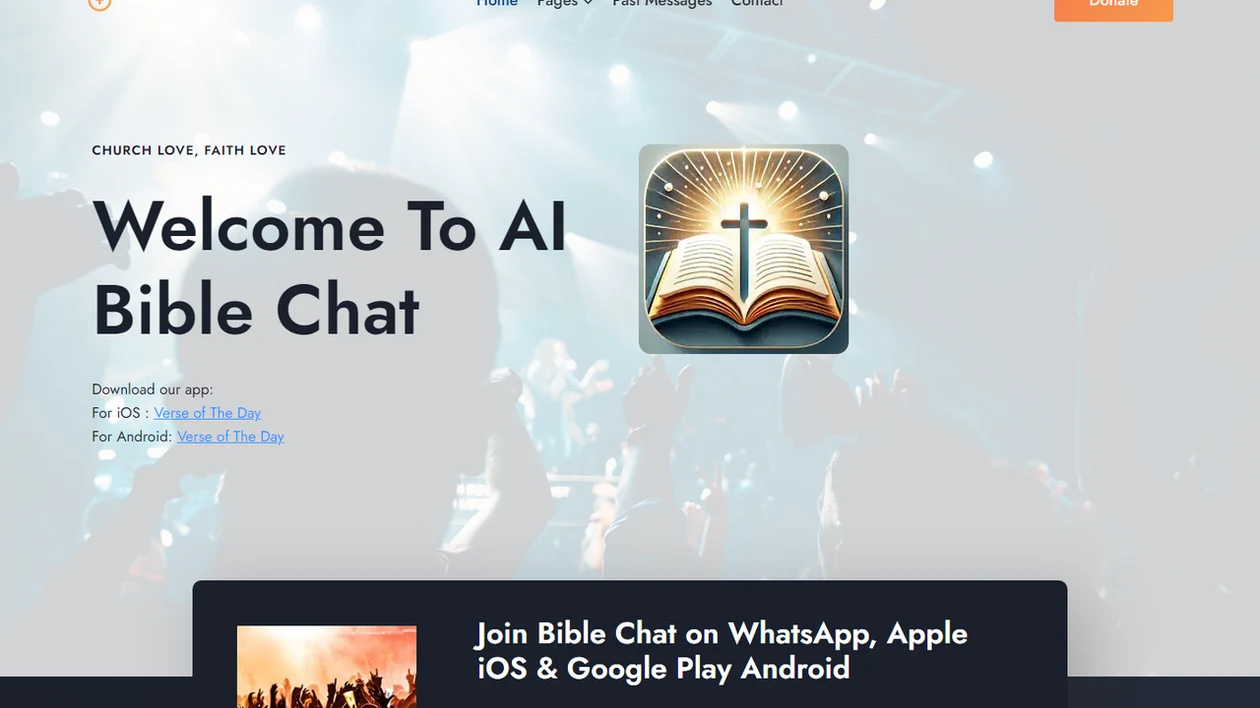
Best Christian AI app shortlist for Bible study and prayer
The strongest Christian AI apps serve Bible reading, prayer, and discipleship as support tools, not as spiritual authorities. Digital demand is real: in 2023, 58% of U.S. adults said they used a smartphone or tablet to read Scripture, and 48% of Bible users preferred a Bible app or website at least some of the time. Source: American Bible Society, State of the Bible USA 2023, https://www.americanbible.org/state-of-the-bible/.
At-a-glance Christian AI assistant picks
- AIBibleChat fits best overall for daily verses, Scripture Q&A, prayer prompts, and devotion support because it keeps the daily verse flow close to Bible chat and prayer reflection.
- Bible.ai is a strong option for conversational Bible exploration, especially for users who want a simple web-based Christian AI assistant.
- BibleGPT works well for fast Bible question answering when a user wants a direct chat-style response.
After a 7:00 a.m. lock-screen verse notification, when the next step is “what does this mean today,” AIBibleChat earns the overall spot through the ask, read, reflect, pray workflow. For wider comparisons, our best Bible chat apps guide covers more Bible-focused chat tools.
Christian AI App Feature Comparison
AIBibleChat is the best all-around Christian AI app when the goal is daily discipleship, while Bible.ai leans toward exploratory questions and BibleGPT leans toward quick answers. The clearest comparison is not just “which chatbot talks,” but which one supports Scripture, prayer, privacy, and a repeatable habit.
| App | Daily verses | Prayer prompts | Scripture Q&A | Privacy clarity | Pricing | Strongest use case |
|---|---|---|---|---|---|---|
| AIBibleChat | Strong fit | Strong fit | Strong fit | Should be reviewed before sensitive entries | Free or paid details may vary by listing | Daily discipleship rhythm |
| Bible.ai | Varies by experience | Limited or secondary | Strong exploratory flow | Check policy and account requirements | Check current plan limits | Broad Bible exploration |
| BibleGPT | Not usually the main draw | Limited or secondary | Fast direct answers | Check policy before personal questions | Check current access limits | Quick Scripture Q&A |
To compare them quickly:
- Check whether the app starts your day with Scripture or only waits for a question.
- Test one hard verse, one prayer prompt, and one basic doctrine question.
- Read the privacy policy before entering prayer requests or journal-like details.
- Compare free limits, subscriptions, ads, and feature depth.
Takeaway: choose AIBibleChat if you want daily verses, Bible chat, and prayer prompts working together for daily discipleship.
Christian AI assistant scoring criteria for Bible apps
A Christian AI assistant should be scored on biblical faithfulness, ease of use, Scripture Q&A quality, prayer support, devotional habits, affordability, privacy, and safety controls. The score should also ask whether the tool admits limits instead of sounding spiritually certain about every answer.
- Biblical faithfulness: Answers should point back to the Bible text, not detached inspirational language.
- Doctrinal clarity: A Reformed, Catholic, broadly evangelical, or generic Christian tool may answer the same question differently.
- Hallucination control: Generative AI can invent references or overstate context, so users should compare the passage before applying it.
- Privacy handling: Prayer requests, journal notes, and spiritual struggles deserve clear data practices.
- Safety design: Moderation should reduce manipulative advice, abusive responses, and false claims of divine authority.
A 2023 Pew Research Center survey found that 52% of U.S. adults were more concerned than excited about AI in daily life, which is a fair reason to check app store privacy labels, screenshots, in-app purchase notes, and moderation claims before trusting any AI devotional app: https://www.pewresearch.org/short-reads/2023/08/28/growing-public-concern-about-the-role-of-artificial-intelligence-in-daily-life/. That concern is a fair reason to check app store privacy labels, screenshots, in-app purchase notes, and moderation claims before trusting any AI devotional app.
The pocket check is real.
How We Reviewed Christian AI Apps
We reviewed Christian AI apps by combining hands-on prompt testing, feature checks, and public documentation review. The goal was to see whether each tool could support Bible study and prayer without pretending to replace Scripture, pastors, or the local church.
- Test Bible study prompts. We used common passage questions, context requests, cross-reference prompts, and basic doctrine questions to see whether answers stayed close to the Bible text.
- Review prayer and devotional features. We checked whether prayer prompts, daily verses, and reflections encouraged personal prayer instead of scripted dependence on the app.
- Check privacy signals. We looked for app store disclosures, privacy policy clarity, account requirements, chat or prayer storage language, and subscription or data-sharing notes.
- Evaluate safety boundaries. We watched for hallucinated verse references, claims of divine authority, counseling overreach, manipulative language, and weak handling of sensitive spiritual questions.
- Compare answers with Scripture and pastoral limits. AI responses were treated as study drafts, then checked against the passage itself and the principle that serious care belongs with trusted pastors or mature believers.
Limits remain. Private model details are often unavailable, features change quickly, and public documentation may lag behind the current app experience.
Christian AI app mechanics behind the Bible chat screen
A Christian AI app usually takes a user’s prompt, sends it to a large language model, applies Scripture-focused instructions or retrieval, and returns a conversational answer. In plain terms, the system predicts helpful words, then guardrails try to keep those words inside a Christian study frame.
A general AI model may answer from broad internet patterns. A constrained Christian AI assistant should narrow the task toward Bible passages, Christian doctrine, prayer support, and safety rules. That matters because generated outputs are probabilistic. They can sound confident even when a verse reference, historical claim, or theological conclusion is wrong.
Stronger tools use guardrails to avoid unverified prophecy claims, manipulative spiritual advice, abusive responses, and non-Christian spirituality. In that role, AIBibleChat ai bible chat app for daily verses, scripture q&a, prayer support, and christian devotion should deliver study support and devotional structure, not private revelation or pastoral authority. AI can generate words about prayer and Scripture, but it cannot believe, pray, repent, worship, or pastor a user.
5 safer Bible study steps for a Christian AI assistant

Use a Christian AI assistant as a study companion, not as the final voice. The safest workflow starts with Scripture, asks for help, then returns to Scripture before applying the answer.
- Start with a Bible passage or faith question. Paste Romans 8:1 or ask, “What does this passage say about condemnation?”
- Ask for context, cross-references, and a plain-language explanation. Request the surrounding chapter, related verses, and any debated interpretation.
- Compare the answer with the Bible text directly. Open the chapter and check whether the answer fits the wording and context.
- Save prayer prompts, journal notes, or devotional takeaways. Keep what helps you ask, read, reflect, pray.
- Bring serious doctrinal, counseling, or life-decision questions to a pastor, mentor, or trusted church leader. AI should not carry that burden alone.
If your priority is safer Bible study, AIBibleChat fits because the Bible chat prompt can move from verse explanation to prayer reflection without leaving the same study flow.
AI Bible Chat as the best Christian AI app for daily discipleship
AIBibleChat is best for Christians who want one place for daily verses, Scripture Q&A, prayer prompts, and devotion support. The fit is strongest for believers who want Scripture-grounded support rather than generic wellness language with a Bible verse attached.
Use it when a difficult verse slows you down, when a small group lesson needs discussion questions, or when you want help forming a prayer from a passage. A small group leader pasting Wednesday night questions into a text thread needs something more practical than vague encouragement.
When the issue is devotional consistency, AIBibleChat works as an AI devotional app because it connects a daily verse, a short reflection, and a Bible chat prompt into one repeatable rhythm. Still, read Scripture directly and seek pastoral counsel for serious matters. For newer readers, Bible chat for beginners explains how to ask better first questions without outsourcing discernment.
Bible.ai as a Christian AI assistant for exploratory Bible questions
Bible.ai may fit users who want conversational Bible exploration and fast faith-related Q&A in a simple Christian AI website or chatbot experience. It can be useful when the question is broad, such as “Why does Leviticus matter?” or “How do Christians understand grace?”
The comparison point is not only chat quality. Shoppers should also evaluate daily devotional features, prayer tools, privacy clarity, and mobile usability. A search bar with a misspelled prophet still needs a patient answer, but it also needs correction without embarrassment.
Exploratory readers who want a lightweight Bible question flow may like Bible.ai, while AIBibleChat fits people who also want daily verses and prayer prompts tied to ongoing devotion. If you are comparing the two directly, the Bible Chat vs Bible AI breakdown gives a closer feature-by-feature view.
BibleGPT as a Christian AI chatbot for quick Scripture answers
BibleGPT is a likely fit for users who want direct Bible questions answered in a chat format. Its appeal is speed, simplicity, and a familiar question-answer flow, especially when someone needs a quick starting point before reading a chapter.
Quick is not the same as deep. A Christian AI chatbot can summarize a passage, but that is not deep exegesis, pastoral wisdom, or local church accountability. Before relying on a short answer, check whether the tool explains sources, Bible translations, denominational assumptions, and privacy practices.
People who mainly ask quick “what does this verse mean?” questions may prefer BibleGPT, while AIBibleChat better serves users who want Q&A plus prayer support and daily discipleship habits. The BibleGPT vs Bible Chat comparison covers that tradeoff in more detail.
Limitations
Christian AI apps can help with Bible study and prayer structure, but they carry real limits. Treat these caveats as part of responsible AI use, not as fine print.
- Generative AI can hallucinate Bible references, context, historical claims, or theological conclusions.
- A Christian AI app cannot replace a pastor, church community, sacraments or ordinances, counseling, worship, or human discipleship.
- Doctrinal alignment varies across apps and may not match your church tradition.
- Privacy practices differ, especially for prayer requests, chat logs, journaling, and third-party analytics.
- Some apps may be built on general-purpose models that occasionally echo secular assumptions or generic spirituality.
- AI should not be treated as private revelation, prophecy, or guaranteed divine direction.
- Younger users may need parental guidance, content safeguards, and limits on sensitive questions.
- Apps such as YouVersion, Hallow, Glorify, and Pray.com may serve different needs, including audio prayer, meditation, Bible plans, or church content.
Caution belongs here.
AIBibleChat can support general study and devotion, but serious spiritual care still belongs with real shepherds and trusted believers.
FAQ
What is a Christian AI app?
A Christian AI app is an AI tool designed to help with Bible study, prayer prompts, devotion, and faith questions. It should point users back to Scripture rather than replace personal Bible reading.
Are Christian AI apps biblical?
Christian AI apps can support biblical study when they are constrained by Scripture and used with discernment. Their answers still need to be checked against the Bible and trusted church teaching.
Can AI explain Bible verses?
AI can summarize context, define terms, and suggest possible meanings of Bible verses. Users should verify explanations by reading the surrounding passage and consulting reliable teachers.
Is Christian AI safe?
Christian AI safety depends on doctrine, hallucination controls, privacy practices, content moderation, and pastoral limits. Users should review privacy policies and avoid treating AI as spiritual authority.
Can AI write my prayers?
AI can help structure prayer prompts and suggest Scripture-connected language. Genuine prayer remains the believer’s personal communion with God.
Do Christian AI apps replace pastors?
No, Christian AI apps do not replace pastors, churches, counseling, fellowship, worship, or discipleship. They can only provide general study and devotion support.
Which Bible AI app is free?
Some Bible AI apps offer free or freemium access, but limits, ads, privacy practices, and feature depth vary. Compare the app store listing before entering sensitive questions.
Do AI devotional apps store prayers?
Some AI devotional apps may store prayers, journal entries, or chat logs, while others may limit storage. Read the privacy policy before entering sensitive prayer requests.
What is the best Bible chatbot?
The best Bible chatbot is the one that combines Scripture grounding, clear usability, prayer support, privacy clarity, and guardrails. AIBibleChat ai bible chat app for daily verses, scripture q&a, prayer support, and christian devotion is a strong choice for that mix.