
What Does the Bible Say? A Context-First Scripture Topic Guide

The best way to answer “what does the Bible say” is to start with relevant passages, read them in context, compare Scripture with Scripture, and apply the message prayerfully rather than relying on one isolated verse. This guide shows how to move from a life question to a trustworthy Bible topic study.
> Definition: A Bible topic guide is a Scripture discovery tool that groups related passages by life issue while preserving context, cross-references, and the broader message of the Bible.
TL;DR
- Use topical Bible searches to find starting passages, not final answers.
- Read the surrounding chapter, author, audience, genre, and biblical storyline before applying a verse.
- AI Bible Chat can speed up verse discovery, Scripture Q&A, prayer prompts, and devotion support, but every answer should be checked against the Bible itself.
Bible topic guide basics for “what does the Bible say” questions
A Bible topic guide helps you move from a real-life question to connected passages, not just a loose list of verses. People use topical searches for anxiety, forgiveness, money, relationships, purpose, work, grief, and God’s will.
A good guide gives the verse, a short explanation, cross-references, and enough context to keep the passage from being bent out of shape. If you search what does Bible say about anxiety, for example, you should see more than Philippians 4:6. You should also see Psalms, Jesus’ teaching, and the wider Bible’s language about fear, trust, and prayer.
For example, a study on anxiety should not stop at Philippians 4:6–7. It should also consider Jesus’ teaching in Matthew 6:25–34, lament language in the Psalms, and passages about casting cares on God such as 1 Peter 5:7.
The cross-reference footnote matters.
Tools like AIBibleChat can support this pattern as a Bible chat app for daily verses, scripture Q&A, prayer prompts, and devotion support for Christians. Still, the Bible remains the text to test every answer against.
At-a-glance Scripture by topic reading path
Start with your question in plain language, then widen the search before you apply anything. “What does the Bible say about forgiveness?” is clearer than “verses for someone who hurt me,” because it gives the study a biblical theme to follow.
Find several related passages, not one favorite verse. Read the surrounding chapter and ask basic context questions: Who is speaking? Who is being addressed? Is this law, poetry, prophecy, gospel narrative, wisdom, or an apostolic letter?
For most readers, a context-first topical study is safer than a quote list because it slows down application until the passage has been heard on its own terms.
After that, compare the passage with the wider Bible. Then turn the study into prayer, obedience, and wise counsel. A blank prayer journal page after reading Matthew 18 can be a better next step than saving ten screenshots.
Before You Start a Bible Topic Study
Before you start a Bible topic study, slow down enough to name what you are really asking and prepare to listen to more than one passage. The first minutes shape whether the study becomes humble Scripture reading or a search for a verse that agrees with you.
- Write the real question: Name the issue plainly before searching for themes, verses, or quick answers. “How do I forgive someone who is not sorry?” will guide a better study than “forgiveness verses.”
- Choose your reading setup: Pick one Bible translation for the main reading, then keep the full chapter open so each verse stays connected to its paragraph and book.
- Identify the kind of topic: Notice whether the issue is practical, doctrinal, emotional, or tied to a crisis. A question about church leadership needs a different pace than a question asked through tears at midnight.
- Decide who should be involved: Bring in a pastor, counselor, or mature Christian friend when the topic involves danger, trauma, major doctrine, abuse, marriage, addiction, or self-harm.
- Prepare to compare passages: Let several Scriptures correct and complete your first impression instead of defending one preferred verse.
Five facts about what the Bible says by topic
- The Bible addresses life topics through law, wisdom, poetry, prophecy, gospel narrative, letters, and apocalyptic writing, not only through direct commands.
- Context includes author, audience, occasion, covenant setting, surrounding verses, and the purpose of the book.
- Trustworthy topic guides connect multiple passages and avoid cherry-picking a verse that already agrees with the reader.
- AI Bible tools can accelerate discovery, summaries, and follow-up questions, but they are not final doctrinal authorities.
- Topical study should complement whole-book reading, prayer, church teaching, and mature Christian counsel.
A small group leader pasting discussion questions into a Wednesday night text thread needs this balance. The question may begin with what does Bible say about forgiveness, but the group still needs the chapter, the speaker, and the call to obey.
How Scripture by topic discovery works
Scripture by topic discovery maps a modern question to biblical themes, keywords, narratives, teachings, and cross-references. It is not only word matching. A search for “social media” may not find a direct phrase, but it can trace biblical ideas about speech, envy, wisdom, temptation, and love of neighbor.
Two light technical terms help here: semantic search and cross-reference mapping. In plain language, semantic search looks for meaning, while cross-references connect passages that help interpret one another.
For AIBibleChat, the better workflow is to surface passages, summarize the immediate context, suggest follow-up questions, and offer prayer prompts while prioritizing the biblical text. AIBibleChat should support daily verses, Scripture Q&A, prayer support, and Christian devotion without presenting itself as new revelation or a replacement voice for God.
Test the answer. Always.
How to use a Bible topic guide without proof-texting
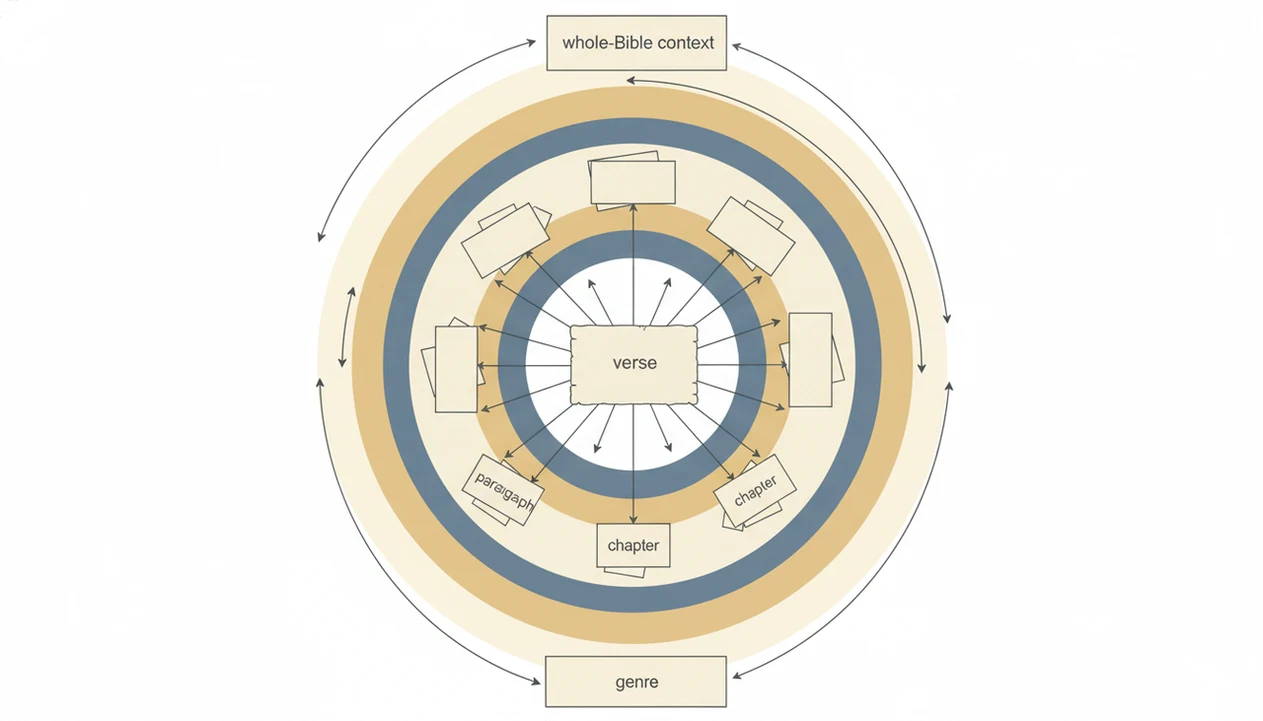
Use a Bible topic guide as a study path, not a shortcut around interpretation. The goal is to ask, read, reflect, pray.
This is especially important when the question comes from a tense moment, such as a late-night argument, a hospital waiting room, or a text from someone asking for immediate advice.
- Ask the question plainly: Write the real question, such as “What does the Bible say about forgiveness?”
- Search for connected passages: Gather several verses across different books, including cross-references.
- Read the chapter: Check the paragraph, speaker, audience, genre, and purpose before applying the verse.
- Compare cross-references: Let clearer passages and repeated biblical themes shape your conclusion.
- Summarize the biblical pattern: State what the passages teach together, not what one line seems to say alone.
- Pray and apply with humility: Ask God for wisdom, then seek wise counsel when the issue is weighty.
A grocery store parking lot before a stressful errand is a real place to ask a Bible chat prompt. It is not the final place to settle hard theology.
Common myths about Bible verses by topic
Myth 1: One verse fully answers every topic. Some questions have direct commands, but many need several passages. A study on what does Bible say about grief should include lament, hope, resurrection, and the comfort of God.
Myth 2: An AI Bible answer is automatically God’s opinion. AI can summarize and connect texts, but it can also flatten disputed passages or miss context.
Myth 3: Topical study replaces reading whole chapters and books. It does not. Topic guides are doorways into Scripture, not substitutes for Scripture.
Myth 4: Every modern issue has a direct word-for-word verse. Social media, technology, addiction, and mental health often require applying biblical principles about wisdom, the body, desire, community, and care.
Not every answer fits on a lock screen.
Digital Bible topic guide habits and Scripture engagement
Digital Scripture discovery matters because many people already meet the Bible through a screen. Pew reported that 44% of U.S. adults read the Bible at least monthly, while 34% never read it, in its religion and electronic media research source. Pew has also reported that about 31% of the world’s population identifies as Christian, which helps explain the broad demand for Bible topic guides source.
Pew data also found that 45% of U.S. adults use a smartphone or tablet to access the Bible or religious content. The American Bible Society reported that many practicing Christians who engage Scripture at least four times a week describe positive effects on decisions and relationships source.
A 7:00 a.m. lock-screen verse notification can start the daily verse flow. But context-first tools should lead readers back to chapters, prayer, and church community, not replace those disciplines.
Limitations
Topical Bible study is useful, but it has real limits. Treat these cautions as guardrails.
- Topical search can encourage proof-texting if the reader has already decided the answer.
- AI Bible Chat tools can oversimplify theology or misread disputed passages.
- No topic guide captures every nuance of Hebrew, Aramaic, Greek, ancient culture, and church history.
- Some answers depend on denominational convictions and should be discussed with pastors or church leaders.
- Finding a verse does not guarantee instant healing, addiction recovery, anxiety relief, or restored relationships.
- Professional help may be needed for abuse, self-harm, trauma, addiction, or mental health crises.
- A topic page may miss passages that use different wording for the same biblical idea.
If someone is in danger, a Bible search is not enough. Contact emergency services, a crisis line, a pastor, or a qualified professional.
Scripture topic guides
Context-first guides for common Bible questions. Each page groups verses with cross-references—not isolated proof texts.
- What the Bible says about lust
- What the Bible says about lying
- What the Bible says about money
- What the Bible says about patience
- What the Bible says about gambling
- What BCE means in the Bible
- What God says about marriage
- What the Bible says about prayer
- Sex before marriage in the Bible
- Psalms 70 explained
- Read the Bible in a year app
- Reincarnation in the Bible
- Sins in the Bible
- What the Bible says about pride
- This too shall pass Bible verse
- What order to read the Bible
- Why Cain killed Abel
- Why Enoch is not in the Bible
- Why Lilith is not in the Christian Bible
- Catholic Bible versions
- Languages the Bible was written in
- Longest book in the Bible
- What is Sheol
- Salvation in the Bible
- Gen Z Bible
- Gen Z Bible translation
FAQ
What does the Bible say?
The Bible reveals God, salvation, wisdom, commands, promises, warnings, and guidance for life through many genres. Its message should be read in context, not reduced to isolated quotes.
How do I find Bible verses?
Search by topic or keyword, then check cross-references and read the surrounding chapter. For prayer themes, you can also find Bible verses for prayer and compare the passages in context.
What is Scripture by topic?
Scripture by topic is the practice of grouping Bible passages around a theme while still reading each passage in context. It helps with questions about faith, suffering, obedience, relationships, and daily life.
Are topical Bible verses reliable?
Topical Bible verses are reliable starting points when they are selected carefully and read in context. They become misleading when they are detached from the author’s meaning and the wider Bible.
What is proof-texting?
Proof-texting is using isolated verses to support a claim without honoring context. It often ignores genre, audience, surrounding verses, and related passages.
Can AI explain Bible verses?
AI can summarize verses, connect passages, and suggest questions for further study. Its answers should be checked against Scripture and, for difficult topics, discussed with mature Christian counsel.
How much context is enough?
Read the surrounding paragraph, the chapter, the book’s purpose, and related passages. More context is needed when the passage is disputed, symbolic, or tied to covenant commands.
Which Bible topics matter most?
Core Bible topics include God, Jesus, salvation, sin, faith, love, prayer, wisdom, suffering, obedience, and hope. Other life topics should be studied in light of these central themes.
Should I read whole chapters?
Yes, whole chapters and books are essential for understanding topical verses. A topic guide can help you begin, but the chapter shows how the verse functions.
Can one verse answer everything?
Some questions have direct verses, but many require several passages and careful application. AIBibleChat can help locate related passages, but the conclusion should be tested by Scripture itself.