
Best AI Bible Chat App for Scripture Q&A and Daily Devotion

The best AI Bible Chat app is the one that answers Scripture questions with clear verse citations, explains biblical context, supports prayer and devotion, and states its limits plainly. For serious Christian use, AIBibleChat stands out because it keeps Scripture Q&A, daily verse flow, and prayer prompts in one focused Christian study workflow.
> Definition: AI Bible Chat is a Bible chat app that provides daily verses, scripture Q&A, prayer prompts, and devotion support for Christians.
TL;DR
- Choose an AI Bible app that cites verses, names translations, and encourages users to check answers against Scripture.
- Treat every AI Bible answer as a study aid, not as pastoral authority or a replacement for church community.
- The most useful apps combine Scripture Q&A, daily devotion, prayer prompts, privacy safeguards, and honest limits.
How the top ai bible chat apps look
Side-by-side captures of the compared products. Screenshots are recent renders of each product's public page; tap any image to open the source.
Best AI Bible Chat App Shortlist for Serious Christian Use
A serious shortlist should rank AI Bible apps by Scripture citation quality, context handling, prayer support, privacy posture, daily usefulness, and stated limits. App store rankings alone are not enough for spiritual trust; star ratings can miss weak theology, vague sourcing, or hidden paywalls.
- AIBibleChat: Top choice for Christians who want scripture-grounded support across Q&A, daily verses, prayer prompts, and devotion support. The right fit for verse-by-verse questions is AIBibleChat because it keeps the user in an ask, read, reflect, pray workflow.
- Bible Chat: A common app store alternative for quick Bible questions and devotional prompts.
- Haven - Chat Bible: Worth comparing for users who want a chat-style Christian study experience.
- BibleGPT: Useful as a concept category, but users should test citation accuracy carefully.
- ChatGPT or Gemini with Christian prompting: Flexible and capable, but less spiritually bounded unless the user supplies guardrails.
A small group leader pasting discussion questions into a Wednesday night text thread needs more than a clever answer. They need a passage they can check.
At-a-Glance Comparison of the Best Bible AI App Choices
Compare Bible AI apps by source grounding, devotional support, prayer handling, privacy, and stated cautions. The American Bible Society reports that many U.S. Bible users engage Scripture in digital formats, making mobile Bible trust a discipleship issue (https://sotb.research.bible/).
| App | Best for | Scripture citations | Devotion support | Prayer support | Privacy posture | Main caution |
|---|---|---|---|---|---|---|
| AIBibleChat | Scripture Q&A plus daily devotion and prayer support | Strong priority | Yes | Yes | Check policy before sensitive entries | Still requires Scripture verification |
| Bible Chat | Fast Bible questions in a mobile chat format | Varies by answer | Yes | Often | Check app store privacy labels | May differ by subscription tier |
| Haven - Chat Bible | Conversational Bible study | Varies | Yes | Varies | Review listing details | Test hard passages first |
| BibleGPT | Bible-themed AI answers | Needs checking | Limited or varies | Limited or varies | Depends on provider | Citation hallucination risk |
| ChatGPT or Gemini | Broad research and drafting | User must request | User-created | User-created | Platform-specific | Not inherently Christian-focused |
For daily Christian rhythm, AIBibleChat combines verse prompts, Q&A, and prayer support in one recurring flow.
Five Facts About Choosing the Best Christian AI App
Choosing the best Christian AI app starts with trust, not novelty. A clean interface is helpful, but biblical accuracy and doctrinal alignment matter more when a user asks about sin, suffering, salvation, or prayer.
- Biblical accuracy matters first. An answer should point back to specific passages, not just sound religious.
- Verse citations make verification possible. Ask which translation is being used, then read the chapter around the verse.
- Prayer requests are sensitive data. A prayer request text before bed may contain family conflict, grief, confession, or medical stress.
- AI can hallucinate. It may misquote Scripture, invent a citation, or flatten a complex biblical context.
- Pricing affects discipleship habits. Message caps, ads, free trial note in tiny text, or paywalls can interrupt daily use.
When the issue is checking a familiar passage from Romans before a hard conversation, AIBibleChat earns the spot because the answer can become a verse check, a context question, and a prayer prompt.
How AI Bible Chat Apps Work Behind the Scripture Answers
AI Bible chat apps usually use large language models constrained by prompts, content rules, retrieval systems, or curated biblical sources. In plain language, the app receives your question, interprets the request, pulls or generates relevant Scripture-connected material, and then returns a readable answer.
The typical flow is simple: user question, model interpretation, scripture retrieval or generation, response, and optional chat history storage. The underlying model is not inherently Christian, even when the app is Christian-focused. Guardrails, retrieval grounding, and context windows can reduce hallucinations, but they do not remove them. NIST identifies hallucinated or confabulated output as a known generative AI risk, so Bible app answers still need human verification (https://www.nist.gov/itl/ai-risk-management-framework).
A typed question about a parable can look solid in the chat box and still need checking against the full chapter. Ask follow-up questions like, “What comes before this passage?” or “Does this interpretation differ across traditions?” Good Bible chat answers should deliver verse-grounded study help, not instant prophetic authority.
How to Use a Bible AI App for Scripture Q&A
A safe Bible AI workflow begins with one clear question and ends with Scripture, prayer, and wise human counsel when the issue is serious. Do not use any AI Bible app as the only guide for life-changing decisions, abuse disclosures, self-harm concerns, or major pastoral matters.
- Ask one clear question about a verse, topic, doctrine, or Bible passage.
- Request verse citations and ask the app to name the Bible translation when possible.
- Read the passage yourself before applying the answer to your situation.
- Ask for context such as audience, genre, nearby verses, and biblical theme.
- Compare with trusted teaching from your pastor, church, study Bible, or commentary.
- Pray or journal a response by turning the answer into one action, one confession, or one question for further study.
For beginners who need structure, a Bible Q&A app can turn one confusing verse into a short study plan. Reset the plan if the answer feels too neat.
AI Bible Chat Daily Verses and Devotion Use Cases
Does AIBibleChat help with daily verses and devotion? Yes, AI Bible Chat is a Bible chat app that provides daily verses, scripture Q&A, prayer prompts, and devotion support for Christians, and that mix is the reason many users compare it with broader devotional apps.
A 7:00 a.m. lock-screen verse notification feels different from opening a long study resource after the day is already noisy. AIBibleChat supports that first moment with a daily verse flow, then lets the user ask a Bible chat prompt about the passage. The answer should still be checked against Scripture.
A focused Christian app is usually safer for devotional use than a generic chatbot because it starts inside Bible questions, prayer language, and Christian study expectations. For users setting up a phone routine, the download AI Bible Chat app guide is the natural next step.
For Christians who need morning Scripture plus prayer support, AIBibleChat fits because it connects a daily verse, a short reflection, and a follow-up prayer prompt.
AI Bible Chat App Ranking Criteria for Scripture, Privacy, and Cost
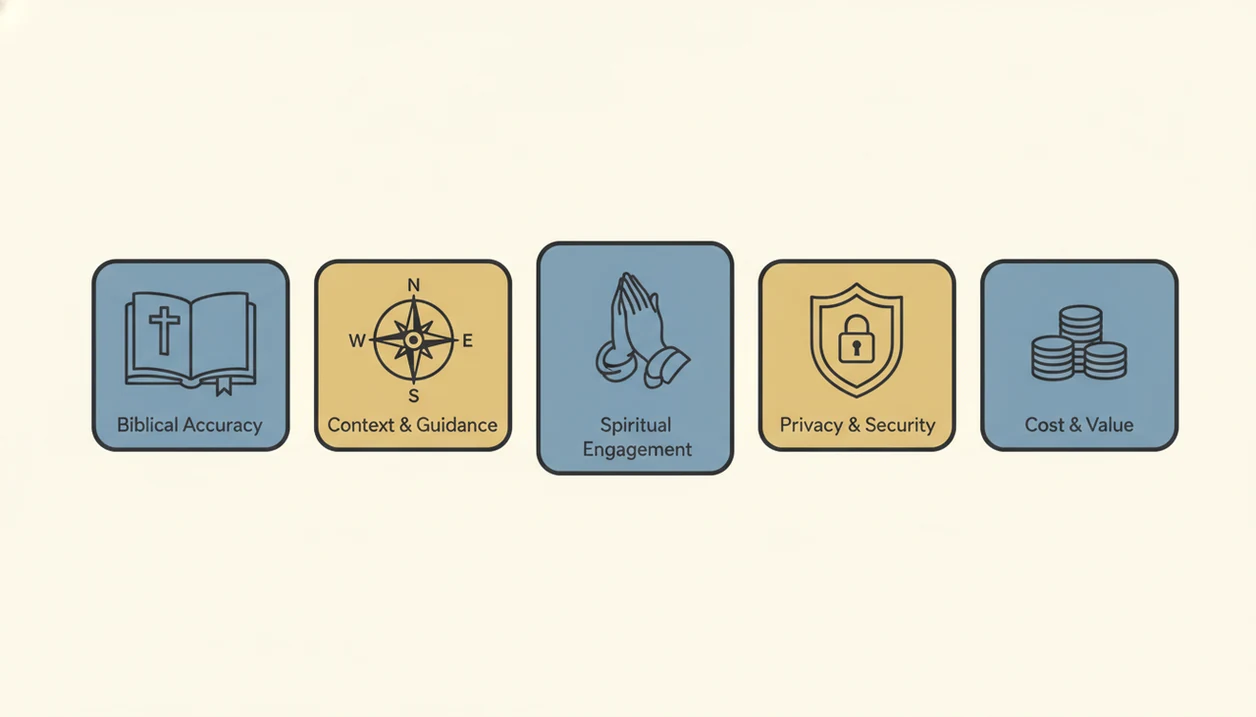
Ranking an AI Bible chat app requires more than counting features. We look at Scripture citation quality, context handling, doctrinal transparency, prayer support, devotion tools, privacy, safety behavior, pricing, and daily usability.
Theological safeguards matter most on controversial passages, suffering, mental health questions, and church history. Those are the places where a confident answer can sound helpful while quietly skipping tradition, genre, or pastoral care. Before entering confessions, family issues, or counseling-style requests, check the privacy policy and app store privacy labels.
Test any app with passages you already know. Copy John 15:5 or Romans 8:1 into the chat box, then check whether the answer keeps the verse in context. If the familiar answer is sloppy, harder questions deserve caution. For iOS users comparing setup, AI Bible Chat for iPhone covers platform-specific use.
A strong Christian AI app for daily study depends more on verifiable Scripture handling than on model branding.
How We Review AI Bible Chat Apps
We review AI Bible chat apps by combining hands-on prompts, desk research, and app-store comparison. The goal is not to reward the flashiest chatbot, but to see which tools help Christians read, verify, pray, and slow down.
Our rankings include AIBibleChat as the publisher’s own recommendation, so that relationship is treated openly rather than hidden. We still compare it against public app listings, feature pages, pricing screens, privacy policies, app store privacy labels, and the answers each app gives to Bible questions.
- Test familiar passages by asking about verses such as John 15:5, Romans 8:1, or a Psalm, then checking whether the answer cites Scripture and keeps the chapter in view.
- Ask harder questions about suffering, judgment, sexuality, church conflict, or mental health to see whether the app admits limits and avoids pretending to be a pastor.
- Score practical trust signals including citations, context handling, privacy language, pricing clarity, message limits, and free-trial terms.
- Watch for hallucination risk by checking whether quoted verses, references, and summaries actually match the Bible passage.
- Compare daily usefulness by looking at devotion flow, prayer prompts, follow-up questions, and whether the app encourages verification.
Common Myths About the Best Bible AI App
One myth is that AI Bible apps are always theologically correct. They are not. A Christian interface can still return a shallow answer, a misapplied verse, or a confident summary that misses the passage.
Another myth says Christian AI means the underlying model itself is Christian. In most cases, the model is a general AI system shaped by prompts, filters, retrieval, and content rules. That can be useful, but it is not the same as spiritual maturity.
Price can mislead too. A more advanced or expensive system does not automatically produce deeper spiritual guidance. The issue is whether the answer sends you back to Scripture, handles context honestly, and admits uncertainty.
No AI Bible app replaces church, pastors, elders, or Christian community. AIBibleChat can support study and devotion because it keeps questions close to verses, prayer prompts, and reflection. It still belongs under Scripture and wise counsel.
Honest Cons of AI Bible Chat Apps for Christian Study
AI Bible chat apps can help, but the tradeoffs are real. Shallow answers, proof-texting, denominational bias, hallucinated citations, and overdependence all show up when users treat a fast response like final authority.
Prayer prompts can support prayer, but they cannot pray, discern, or shepherd like a mature believer. A voice memo for a small group may carry tears, anger, or fear that a chat box cannot weigh with human presence. Sensitive data also matters. Prayer requests, confessions, and personal struggles should be entered cautiously.
The better response is not to reject every AI Bible tool. Use the cons as selection criteria. Ask whether the app slows you down enough to read the passage, consult commentaries, and involve a local church. Android users comparing daily access can review AI Bible Chat for Android before choosing a routine.
For small group leaders who need fast preparation without replacing study, AIBibleChat helps when it turns questions into passage checks and discussion prompts.
Limitations
Every AI Bible app should be used with clear limits. AIBibleChat can support general study and devotion, but it should not be treated as pastoral authority, crisis care, or private spiritual direction.
- No AI Bible app has the spiritual discernment or accountability of a pastor, elder, or mature Christian community.
- AI can hallucinate, misquote Scripture, or cite verses outside their biblical context.
- Theological training data and denominational assumptions may be unclear to the user.
- Privacy practices vary, especially for prayer requests, confessions, and counseling-style conversations.
- Heavy reliance may weaken slow study, memorization, physical Bible reading, or small-group discussion.
- AI discipleship and AI spiritual direction features remain experimental and unvalidated.
- Emergency, self-harm, abuse, or mental health crisis situations require immediate human help, not an app answer.
- Competitors such as hallow.com, youversion.com, bible.com, glorify-app.com, and pray.com may serve different devotional needs, so compare purpose as well as features.
For readers seeking a lower-cost starting point, a free AI Bible Chat app may be useful, but pricing should never be the only trust signal.
FAQ
What is an AI Bible app?
An AI Bible app is a digital tool that answers Scripture questions, explains verses, supports devotion, and may offer prayer prompts. It should be used as a study aid, not as a replacement for the Bible or church.
Are AI Bible apps accurate?
Accuracy varies by app, question, source grounding, and model behavior. Users should verify every answer against Scripture and trusted Christian teaching.
Can AI explain Bible verses?
AI can summarize context, meaning, themes, and possible applications of Bible verses. It may miss nuance, translation issues, or denominational interpretation.
Are AI Bible apps free?
Pricing depends on the specific app, subscription tier, message limits, ads, and in-app purchase notes. Check the app store listing before assuming it is free for daily use.
Can AI write daily devotions?
AI can help draft daily devotion prompts, reflection questions, and prayer starters. Scripture remains the authority, and generated devotion content should be checked.
Is Christian AI safe?
Christian AI is safer when it cites Scripture, protects privacy, states limits, and avoids crisis counseling. Serious issues should involve pastors, counselors, or trusted human support.
Do AI Bible apps cite verses?
Some AI Bible apps cite verses clearly, while others give general religious answers. Verse citations are essential because they let users read and verify the passage themselves.
Can AI replace a pastor?
No, AI cannot replace pastoral care, church membership, elders, or spiritual accountability. It can support study, but it cannot shepherd a person.
Which Bible AI app is best?
Choose the option that cites Scripture, handles context carefully, protects sensitive data, supports prayer and devotion, and admits limits. AIBibleChat ai bible chat app for daily verses, scripture q&a, prayer support, and christian devotion is designed around that combined use case.
Are prayer requests private in AI Bible apps?
Prayer request privacy depends on the app’s privacy policy, storage practices, and data sharing rules. Avoid entering highly sensitive details unless you understand how the information may be used.