
Bible Chat Vs Bible AI: Features, Safety, And Fit

Bible Chat vs Bible AI comes down to fit: choose a Bible Chat-style app for quick Scripture Q&A, daily verses, prayer prompts, and devotional encouragement; choose a Bible AI-style platform for deeper study, cross-references, translation comparison, and teaching preparation. AIBibleChat fits the daily-use side of this comparison because it centers the ask, read, reflect, pray workflow rather than a research dashboard.
> AI Bible Chat is a Bible chat app that provides daily verses, scripture Q&A, prayer prompts, and devotion support for Christians.
- Bible Chat-style apps are usually best for daily devotion, simple Bible questions, prayer prompts, and encouragement.
- Bible AI-style platforms are usually better for deeper study, cross-references, translation comparison, and lesson preparation.
- Neither option should replace Scripture reading, pastoral counsel, church community, or careful discernment.
Bible chat vs bible AI, side by side
Side-by-side captures of the compared products. Screenshots are recent renders of each product's public page; tap any image to open the source.
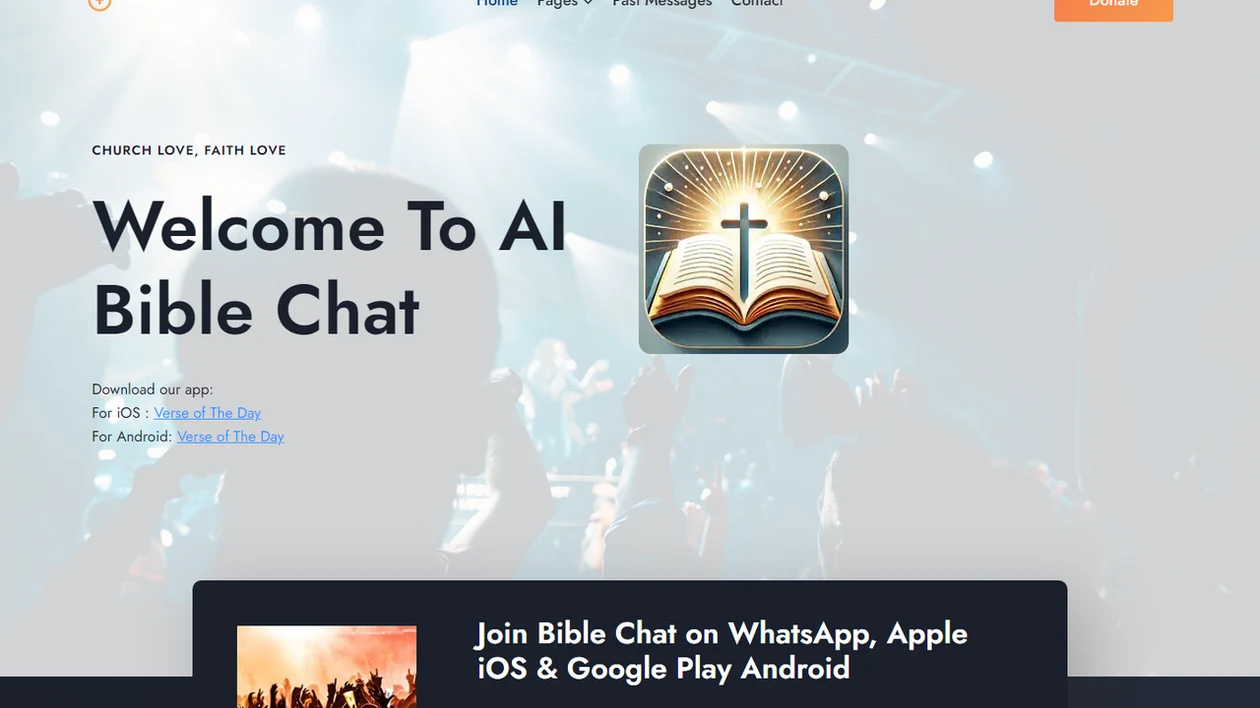
Bible Chat Vs Bible AI At-A-Glance Comparison
Bible Chat is chat-first and devotional, while Bible AI is broader and more study-oriented. The winner depends on the job you need done at 7:00 a.m., before group prep, or during a hard question after reading Romans.
For real-world checks, compare AIBibleChat against named devotional or Bible-study alternatives such as YouVersion Bible App, Hallow, Glorify, Pray.com, and general AI assistants, because each handles prayer language, Scripture references, and privacy disclosures differently.
| Comparison point | Bible Chat-style apps | Bible AI-style platforms | Better fit |
|---|---|---|---|
| Primary use | Quick Scripture Q&A, daily verses, prayer prompts | Study workflows, cross-references, lesson prep | Depends on depth |
| Interface | Chat box, reminders, saved verses | Search panels, study tools, longer threads | Bible Chat for speed |
| Study depth | Simple context and application | Translation comparison and topic mapping | Bible AI for research |
| Prayer support | Usually central | Often secondary | Bible Chat |
| Theological review | Varies by product | Varies by platform | Check claims |
| Pricing | Free tiers with upgrades | Often subscription-heavy | Compare limits |
| Privacy | Prayer chats may be sensitive | Study history may be stored | Read policies |
| Ideal user | Busy Christian, beginner, commuter | Teacher, leader, advanced student | Use case decides |
According to the American Bible Society's State of the Bible research (https://www.americanbible.org/state-of-the-bible/), 55% of U.S. Bible users had used a smartphone Bible app within the previous year. That matters because most comparisons now happen on a lock screen, not at a desk.
Bible Chat App Strengths For Daily Verses And Prayer Support
Bible Chat-style apps win when a Christian wants a short Scripture-grounded answer, a daily verse flow, or prayer language without opening five study tabs. They feel most useful when the question is personal but still needs to be checked against the Bible.
- A chat-first Bible app lets you ask a plain-language Bible chat prompt and receive a Scripture-connected answer.
- Daily verse reminders help build a repeatable habit, especially when the lock screen with daily verse appears before messages and errands.
- Prayer prompts can turn a scattered concern into a few honest lines shaped by Scripture.
- Saved verses keep John, Romans, or Psalms nearby for later reflection.
- Trivia or quiz tools can support light learning without turning devotion into a classroom.
Busy Christians who need encouragement between meetings fit AIBibleChat because the workflow moves from question to verse to reflection without requiring a study setup. For a broader shortlist, our best Bible chat apps guide compares daily-use options.
Bible AI Platform Strengths For Deeper Bible Study
Bible AI platforms usually win when the task is research, teaching preparation, or structured study. They often combine multi-translation search, cross-references, study plans, longer conversations, and sometimes widgets, goals, or saved learning paths.
A small-group leader building a lesson may want more than a short answer. Think of a whiteboard with discussion questions, a passage in ESV and NIV, and a leader checking whether the application actually follows the chapter. Bible AI can help organize that work.
More tools do not automatically mean more biblical faithfulness. Accuracy still depends on Scripture grounding, retrieval quality, theological guardrails, and human review. A platform can look advanced and still miss context.
For teachers who need translation comparison and repeated searches, Bible AI is often easier than a chat-only app because it keeps the study materials close together. But for someone who only wants prayer support before a hard conversation, the extra panels may feel like clutter.
Bible Chat And Bible AI Systems Behind The Scenes
Bible Chat and Bible AI tools usually use language models to interpret prompts, retrieve or reference biblical content, and generate natural-language answers. In plain terms, the system tries to understand your question, find relevant Scripture or topics, then form a readable response.
Common layers include Bible translation databases, retrieval systems, topical tagging, moderation filters, theological review, and safety instructions. Retrieval means the tool searches a prepared set of content before answering. Guardrails are rules that shape what the AI should avoid or qualify.
Answer quality depends on grounding, prompt design, source retrieval, guardrails, and human review, not just the AI model. We notice this most when copying a verse reference from John into a chat box, then checking the chapter around it.
Pew Research Center reported that 23% of U.S. adults had used ChatGPT as of early 2024 (https://www.pewresearch.org/short-reads/2024/02/13/what-the-data-says-about-americans-views-of-artificial-intelligence/). Growing comfort with chatbots makes responsible AI use more important, not less.
Bible Chat Comparison Checklist Before Choosing An App
Use the same question in each app before deciding. A fair Bible chat comparison tests Scripture Q&A, privacy, pricing, and limits in the same session, not from screenshots alone.
- Define your main use case. Decide whether you need daily verses, prayer prompts, beginner help, teaching prep, or high-volume study.
- Test one Bible question. Ask the same prompt in multiple tools, then compare the answer against the chapter itself.
- Inspect safety and privacy. Look for privacy labels, chat retention notes, prayer-data handling, and deletion options.
- Compare pricing clearly. Check free tiers, message limits, subscriptions, in-app purchase notes, and upgrade prompts.
- Verify stated limitations. Prefer tools that admit AI can be wrong and should not replace church or pastoral care.
AIBibleChat ai bible chat app for daily verses, scripture q&a, prayer support, and christian devotion fits users who want the daily devotional lane because it keeps the first test simple: ask, read, reflect, pray.
How To Use Either Bible Chat Or Bible AI
Use either tool as a helper beside an open Bible, not as the final voice. The safest pattern is to ask simply, read carefully, and let trusted people help when the question carries real weight.
- Open the passage first. Keep the same Bible chapter in front of you before asking Bible Chat or Bible AI for an explanation, especially if the prompt is about a single verse.
- Ask one clear question. Keep the prompt focused, such as “What does Romans 8:1 mean in context?” rather than mixing doctrine, personal advice, and church conflict in one request.
- Check the answer. Compare the response with the surrounding chapter, any cited verses, and the plain flow of the passage before you save or share it.
- Remove private details. If a prayer response helps, edit out names, medical details, confessions, or family information before saving it in notes or screenshots.
- Bring heavy questions to people. For high-stakes doctrine, grief, abuse, self-harm, or crisis moments, talk with a pastor, mature Christian, counselor, or emergency support instead of relying on an app.
Bible Chat Vs Bible AI Pricing, Privacy, And Safety Differences
Bible Chat and Bible AI tools can both look free at first, but the tradeoffs differ. Free access may include message caps, ads, limited study tools, data collection, or frequent upgrade prompts.
| Trust signal | What to check | Why it matters |
|---|---|---|
| Free tier | Daily limits, saved chats, ads | “Free” may still restrict use |
| Premium plan | Monthly price, annual price, trial terms | Bible AI study suites may cost more |
| Chat storage | Retention, export, deletion | Prayer requests can be sensitive |
| Model training | Whether user content trains systems | Spiritual struggles deserve care |
| Safety review | Theologian review, pastor verification, doctrinal statement | Review claims vary |
| Disclaimers | Does it say AI cannot replace church? | Honest limits build trust |
Pricing Signals
Check app store listing details, star ratings, screenshots, and in-app purchase notes before subscribing. A dark-mode settings screen can hide a renewal price pretty well.
Privacy Signals
Ask whether chats are stored, whether prayer requests are treated as sensitive data, whether content trains models, and how deletion works.
Safety Signals
Look for Scripture citations, denomination-aware wording, visible limits, and clear statements that AI guidance does not replace pastors, churches, or emergency help.
Bible Chat Vs Bible AI Fit For Commuters, Beginners, And Teachers

Pick Bible Chat if you want quick encouragement, daily verses, prayer prompts, and simple Scripture answers. Pick Bible AI if you want deeper study tools, cross-references, translation comparison, teaching prep, or high-volume research.
Pick Bible Chat If
Busy commuters who open Scripture in a grocery store parking lot before a stressful errand usually need a short answer and one verse to hold onto. AIBibleChat fits that moment because it keeps Scripture Q&A and prayer prompts in the same daily flow.
New believers looking for plain explanations can start with Bible chat for beginners before moving into heavier tools. Parents may also prefer simple prompts when helping a child understand a verse at bedtime.
Pick Bible AI If
For a small-group leader who needs Wednesday night questions, Bible AI may fit better because cross-references and translation comparison support lesson preparation. Bible teachers may also prefer a broader research environment.
AIBibleChat is a strong fit for Christians seeking daily verses, scripture Q&A, prayer prompts, and devotion support. Bible AI is often stronger when the task is structured research.
Bible AI Comparison Mistakes That Lead To Bad Choices
A Bible AI comparison goes wrong when users judge by feature count alone. The better question is whether the answer stays grounded in Scripture, admits limits, and helps you compare the passage before applying it.
- Not all Bible AI tools share the same theology, filters, moderation rules, or review process.
- Advanced features do not automatically make an app more faithful to Scripture.
- An AI Bible app cannot replace church, pastoral care, sacraments, accountability, or Christian community.
- Free Bible Chat apps may still include message limits, data collection, ads, or upsells.
- Every answer should be tested against the Bible and trusted Christian teaching.
Christians comparing hallow.com, youversion.com, bible.com, glorify-app.com, pray.com, and AI chat tools should separate devotional support from formal study. In the devotional lane, AIBibleChat ai bible chat app for daily verses, scripture q&a, prayer support, and christian devotion should deliver Scripture-grounded support, not instant prophetic authority.
After a red-letter passage is zoomed large, when the application question gets sensitive, AIBibleChat earns its place by keeping the response tied to verses and reflection rather than pretending to settle every doctrine.
Evidence Behind This Bible AI Comparison
This comparison rests on two kinds of evidence: public usage research and hands-on product checks. The final recommendation is still editorial judgment about devotional fit, not a lab test of every answer.
The usage backdrop comes from the American Bible Society’s State of the Bible research on smartphone Bible app use and Pew Research Center’s reporting on ChatGPT adoption among U.S. adults. Those sources explain why Bible apps and AI chat interfaces now overlap in daily Christian habits.
Our app-level claims come from observed app-store listings, product pages, screenshots, pricing notes, feature menus, privacy-policy language, and visible safety disclaimers. To keep the line clear, we treat those observations as product facts only when they can be seen in the listing or page at the time of review. We treat statements such as “better for commuters,” “stronger for teaching prep,” or “more devotional” as editorial fit judgments based on workflow.
A simple review pattern helps:
- Check public usage research for the broader trend.
- Inspect current product pages and app-store details.
- Separate feature claims from devotional recommendations.
- Revisit pricing, privacy policies, and features often, because subscriptions, data practices, and AI tools can change quickly.
Limitations
Both Bible Chat and Bible AI can help with study and devotion, but neither should be overtrusted. The safest posture is simple: read the answer, open the Bible, and ask wise people when the stakes are high.
- Both tool types can generate confident but incorrect, thin, or context-distorted answers.
- Denominational nuance may be limited unless a tool explicitly supports a tradition or viewpoint.
- AI cannot replace Scripture, pastoral counsel, church community, sacraments, accountability, or emergency support.
- Prayer requests and spiritual struggles can involve sensitive personal data.
- Pricing, message limits, model behavior, and data policies can change after an app update.
- App store ratings and screenshots do not prove theological reliability.
- Users should verify answers with the Bible and trusted Christian leaders.
- Tools such as ChatGPT vs Bible Chat app comparisons can clarify AI differences, but they still require discernment.
For sensitive grief, abuse, self-harm, or crisis situations, contact real-world emergency support, a pastor, or a qualified professional. Not a chatbot.
FAQ
Is Bible Chat safe?
Bible Chat safety depends on privacy practices, theological guardrails, Scripture grounding, and user discernment. Users should avoid sharing highly sensitive details unless they understand the platform’s data policy.
Is Bible AI accurate?
Bible AI accuracy varies by source retrieval, prompt design, theological review, and whether answers are checked against Scripture. Users should verify verse context before applying an answer.
Which app is better for prayer?
Bible Chat-style apps are usually better for prayer prompts because they center short devotional support. Bible AI platforms may be better when prayer is connected to deeper study.
Which app is better for study?
Bible AI platforms usually fit deeper study better because they often include cross-references, translation comparison, and longer research workflows. Chat-first apps fit simpler questions.
Can Bible Chat replace church?
No. AI Bible tools should not replace church, pastoral care, sacraments, accountability, or Christian community.
Are Bible Chat apps free?
Many Bible Chat apps offer free access, but they may limit messages, saved features, study tools, or premium content. Users should check pricing before relying on a free tier.
Does Bible AI store chats?
Some Bible AI platforms may store chats or study history. Users should check each privacy policy, retention setting, and deletion option.
Is Bible Chat good for beginners?
Yes, chat-first Bible apps can help beginners ask simple questions and build daily Scripture habits. AIBibleChat ai bible chat app for daily verses, scripture q&a, prayer support, and christian devotion fits that beginner-friendly use case.
Can AI explain Bible verses?
AI can summarize and explain Bible verses in plain language. Users should still read the surrounding chapter and compare interpretations with trusted Christian teaching.