
ChatGPT vs Bible Chat App for Scripture Questions

A dedicated Bible chat app is usually the better choice for devotional Scripture questions, while ChatGPT is better for broad research and comparing viewpoints. ChatGPT vs Bible Chat app comes down to scope: general AI can discuss almost anything, but AIBibleChat helps keep Bible questions tied to Scripture, Christian context, prayer, and devotion.
> Definition: AI Bible Chat is a Bible chat app that provides daily verses, scripture Q&A, prayer prompts, and devotion support for Christians.
- Choose ChatGPT for broad research, historical background, writing help, and comparing interpretations across many sources.
- Choose a dedicated Bible AI app for Scripture-first answers, daily verses, prayer prompts, and Christian devotion support.
- Use either tool as a secondary aid, not as a replacement for reading the Bible, prayer, trusted teachers, or church community.
Chatgpt vs bible chat app, side by side
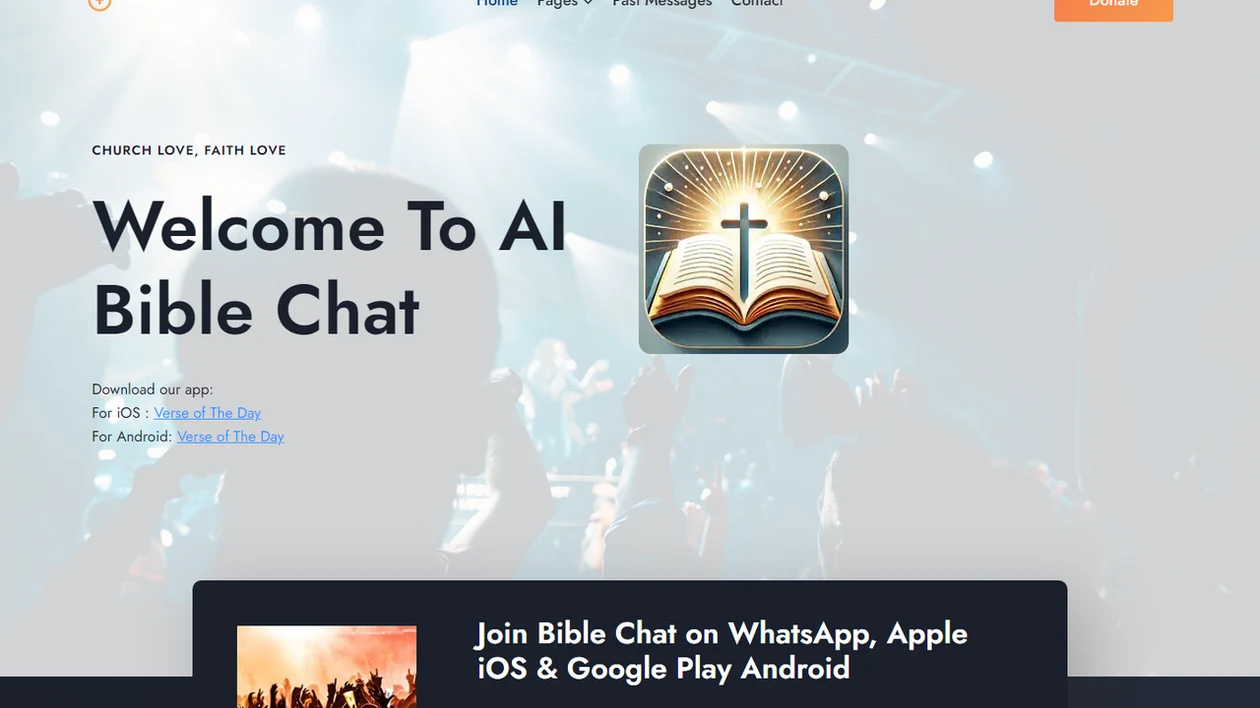
Side-by-side captures of the compared products. Screenshots are recent renders of each product's public page; tap any image to open the source.
ChatGPT vs Bible Chat App at a Glance

ChatGPT wins when the task is broad research, drafting, or comparing many viewpoints. A dedicated Bible AI app wins when the task is Scripture-focused devotion, prayer support, and daily Bible engagement.
| Comparison point | ChatGPT | Dedicated Bible AI app |
|---|---|---|
| Source scope | Broad internet-scale patterns and mixed viewpoints | Narrower Bible-first experience |
| Best use | Research, outlines, summaries, writing help | Scripture Q&A, daily verses, prayer prompts |
| Citations | Must be requested and checked | Often designed around verse references |
| Prayer support | Can draft prayers in many styles | Usually includes guided Christian prayer prompts |
| Worldview guardrails | General-purpose and mixed | More explicitly Christian in framing |
| Verification need | High | Still high |
Neither option should be treated as infallible or as a replacement for Scripture. The notebook margin beside Romans still matters; copy the reference, read the chapter, then decide what the answer got right.
Five Facts About ChatGPT Bible Study and Bible AI Apps
Before choosing between ChatGPT Bible study and a dedicated Bible AI app, remember that the tools are built for different jobs. The difference shows up fastest when you ask a pastoral, doctrinal, or devotional question.
- ChatGPT is a general-purpose large language model that predicts helpful responses from broad training patterns and user prompts.
- ChatGPT answers may reflect Christian, secular, skeptical, and non-Christian perspectives in the same response.
- Dedicated Bible AI apps are constrained or tuned toward Scripture questions, Christian resources, and devotional use.
- Bible AI apps often include daily verses, devotional reflection, prayer prompts, and Scripture Q&A in one flow.
- Both tools can hallucinate verse references, quotations, historical details, or doctrinal summaries, so users should verify answers against the Bible and trusted resources.
On days when a 7:00 a.m. lock-screen verse notification is the habit you are trying to protect, AIBibleChat fits better than a blank general chat box because the daily verse flow starts with Scripture before commentary.
How ChatGPT and a Dedicated Bible AI App Work
ChatGPT and Bible AI apps both generate language by using model inference, which means they predict a useful next response from the prompt and learned patterns. OpenAI describes ChatGPT as a system that generates responses from user prompts rather than a source that guarantees factual accuracy: https://help.openai.com/en/articles/6783457-chatgpt-general-faq. The practical difference is not that one “knows God” and the other does not; it is source scope, constraints, and product design.
ChatGPT is built for wide conversation. A dedicated Bible AI app narrows the experience toward Scripture questions, verse explanation, prayer prompts, and Christian devotional use. That narrowing can reduce drift, but it does not remove the need for discernment.
Prompt quality matters. So do citations, translation awareness, and whether the answer compares the passage before applying it. When someone pastes John 15 into a chat box, a better answer should notice the surrounding chapter, not only the phrase that was copied.
If the priority is Scripture-grounded support rather than general brainstorming, AIBibleChat earns the spot because the workflow centers on ask, read, reflect, pray.
Where ChatGPT Wins for Bible Research
Does ChatGPT help with Bible study? Yes, especially when you need summaries, lesson outlines, historical background, or a quick comparison of interpretive views.
Broad knowledge helps when the question reaches beyond one passage. ChatGPT can explain Roman citizenship in Acts, summarize Second Temple Jewish background, or draft small group questions for a Wednesday night text thread. It can also help a leader turn notes into a cleaner handout before people arrive.
But breadth cuts both ways. A broad answer may blend evangelical, Catholic, Orthodox, liberal academic, secular, and skeptical assumptions without naming the shift. Ask for Bible references, sources, denominational context, and uncertainty.
A practical prompt is: ‘Give three major Christian interpretations of this passage, name the tradition usually associated with each view, and include Bible references I can check.’ That forces ChatGPT to separate viewpoints instead of blending them into one smooth answer.
For teachers and group leaders, ChatGPT is often more useful than a Bible-only app for drafting and comparing perspectives because it can move across history, language, and writing tasks quickly. Then check everything.
Where a Dedicated Bible AI App Wins for Scripture Questions
Dedicated Bible AI apps are designed for Bible answers rather than open-ended conversation. That makes them a better fit when the real need is daily Scripture engagement, prayer prompts, devotional reflection, or a plain-language explanation of a verse.
AIBibleChat is a Bible chat app that provides daily verses, scripture Q&A, prayer prompts, and devotion support for Christians. AIBibleChat works best as a study companion, not as a pastor, priest, counselor, or replacement for the Bible.
Information retrieval is not the same as spiritual formation. A quick answer can explain Romans 8:1, but formation includes repentance, worship, obedience, and community.
When prayer support is the issue, AIBibleChat fits because it can turn a concern into a Scripture-connected prayer prompt without pretending to speak for God.
Good Bible chat apps deliver Scripture-first guidance and devotional structure, not an instant prophetic answer or a substitute church.
How to Use ChatGPT Bible Study Tools Safely
Use AI Bible study tools as secondary aids, not as authorities over Scripture. The safest pattern is simple: read first, ask carefully, verify, then discuss hard questions with mature Christians.
- Read the passage first in your Bible before asking AI to explain it.
- Ask focused questions such as “What is the context of Romans 8:1?” instead of “Explain Christianity.”
- Request citations for Bible references, translation notes, and any historical claims.
- Check the context by reading the chapter before and after the quoted verse.
- Compare trusted resources such as study Bibles, commentaries, pastors, or trained teachers.
- Discuss hard issues with church leaders when the question involves sin, trauma, doctrine, marriage, grief, or major decisions.
If your priority is a beginner-friendly routine, AIBibleChat works well because the app can move from a question to a verse explanation and then into a short reflection. Our Bible chat for beginners guide covers that slower learning path.
Privacy, Citations, and Policy Differences in Bible Chat Apps
Privacy and citations matter because Bible questions often include sensitive personal information. A prayer request about relapse, marriage conflict, doubt, or grief should be treated more carefully than a generic writing prompt.
Check whether the service cites Bible translations, verse references, Christian sources, or only gives confident-sounding summaries. Transparent source grounding is better than generic AI confidence. A citation still needs checking, but at least it gives you a place to start.
Before using any Bible chat app, review the privacy policy, account settings, data retention language, and deletion options. Also check app store signals such as star ratings, screenshots, privacy labels, and in-app purchase notes. The pocket check is real.
For app privacy checks, Apple’s App Privacy Details and Google Play’s Data safety section are useful starting points because they summarize developer-disclosed data collection and sharing practices: https://support.apple.com/en-us/102399 and https://support.google.com/googleplay/answer/11416267.
AIBibleChat should be compared on the same trust factors as YouVersion, Bible.com, Hallow, Glorify, or Pray.com: source clarity, prayer-data sensitivity, and whether the answer sends you back to Scripture. For adjacent options, our Bible Chat alternative page maps the tradeoffs.
Who Should Pick ChatGPT or a Dedicated Bible AI App
Many Christians may benefit from both tools, but not for the same task. Use ChatGPT for broad research and drafting; use a dedicated Bible AI app for Scripture-centered daily practice and devotional questions.
| User need | Better fit | Why |
|---|---|---|
| Compare several theological views | ChatGPT | Broad perspective range |
| Draft a lesson or email | ChatGPT | Flexible writing support |
| Build a daily verse habit | Dedicated Bible AI app | Scripture-first rhythm |
| Shape a prayer from a concern | Dedicated Bible AI app | Devotional prompt structure |
| Resolve doctrinal conflict | Neither alone | Needs Scripture, church, and trusted teachers |
Pick ChatGPT when broad research matters
Pick ChatGPT when you need background, outlines, summaries, or multiple interpretive angles. Ask it to name uncertainty, then verify.
Pick a Bible AI app when Scripture focus matters
Small group leaders trying to keep discussion anchored can use AIBibleChat because it moves from Bible chat prompt to verse references, reflection, and prayer. For broader comparisons, our best Bible chat apps guide separates daily devotion tools from research-heavy tools.
Evidence and Sources Behind This Comparison
This comparison is based on public product behavior, developer disclosures, and documented AI limitations. It is not a claim that one rating, label, or confident answer can prove theological accuracy.
The ChatGPT side should be read alongside OpenAI’s own explanations of capabilities, limitations, and accuracy warnings. The Bible app side should be checked through visible app features, privacy policies, Apple App Privacy labels, and Google Play Data safety disclosures. Named alternatives such as YouVersion, Bible.com, Hallow, Glorify, Pray.com, and AIBibleChat can be compared by looking at what users can actually see: verse tools, prayer flows, subscriptions, account requirements, source clarity, and data-use summaries.
A careful review process looks like this:
- Separate product observations from sourced facts, such as “this app shows daily verses” versus “this platform warns that outputs may be inaccurate.”
- Check privacy labels and policies before entering prayer requests, confessions, or family details.
- Compare Bible references, translation notes, and devotional claims against the passage itself.
- Treat ratings and AI confidence as usability signals, not theological proof.
- Bring difficult doctrinal or pastoral questions back to Scripture, church leadership, and trusted teachers.
Common Myths About ChatGPT Bible Study
Several myths make people overtrust AI Bible answers. Correcting them helps keep the Bible, not the chatbot, in the place of authority.
- Myth 1: ChatGPT is a Christian AI by default. ChatGPT is a general AI and can answer from mixed religious, secular, and non-Christian frames.
- Myth 2: Bible AI apps are infallible because they are Scripture-focused. A Bible-first design can help, but it can still misquote, flatten doctrine, or miss context.
- Myth 3: Verse references prove the answer checked the full passage. A reference may be correct while the application ignores the paragraph around it.
- Myth 4: AI removes the need to read the Bible personally. Christian study still requires reading, prayer, obedience, and community.
AIBibleChat ai bible chat app for daily verses, scripture q&a, prayer support, and christian devotion is useful when it points users back to the text. Our BibleGPT vs Bible Chat comparison explains why “Bible-trained” claims still need verification.
Limitations
AI tools can support Bible study, but they have clear limits. Treat these limits as guardrails, not fine print.
- Both ChatGPT and Bible AI apps can hallucinate verse references, quotations, doctrines, or historical details.
- AI cannot repent, believe, pray, pastor, baptize, shepherd, or spiritually discern like a mature Christian.
- A Bible-focused app can still oversimplify denominational differences, disputed doctrines, or difficult passages.
- ChatGPT can sound balanced while quietly blending incompatible theological views.
- Private spiritual information should be shared carefully, especially prayer requests, confessions, trauma details, or family conflict.
- Users must verify answers against Scripture, trusted commentaries, and church leadership.
- App store ratings, screenshots, and privacy labels help, but they do not prove theological accuracy.
- Daily verse notifications can build a habit, but they cannot replace deeper reading across whole books of the Bible.
For sensitive doctrinal questions, AIBibleChat can help you form better questions because the chat flow keeps the passage visible. The final answer still belongs under Scripture and wise Christian counsel.
FAQ
Is ChatGPT good for Bible study?
ChatGPT can help with summaries, study prompts, outlines, and historical background. Its answers should be checked against Scripture, context, and trusted Christian resources.
Is ChatGPT a Christian AI?
ChatGPT is not a Christian AI by default. It is a general-purpose AI system and does not have a built-in Christian belief system.
Can ChatGPT quote Bible verses?
ChatGPT can provide Bible verse references and quotations. It may misquote, cite the wrong verse, or use a verse outside its context.
Are Bible chat apps accurate?
Bible chat apps can be more Scripture-focused than general AI tools. They are not infallible and still require verification.
Which app is better for prayer?
ChatGPT can draft prayer language in many styles. A dedicated Bible AI app is usually better for Scripture-connected prayer prompts and devotional support.
Can AI replace a pastor?
AI cannot replace pastoral care, Christian community, accountability, or spiritual discernment. Serious spiritual, relational, or crisis issues should be brought to trusted people and appropriate professionals.
Do Bible AI apps cite Scripture?
Some Bible AI apps cite Scripture, verse references, or translations. Users should still check the passage, translation, and surrounding context.
Is AI Bible study safe?
AI Bible study can be safe when users protect private information, expect possible errors, and verify answers. It becomes risky when treated as an authority over Scripture.
Should Christians use ChatGPT?
Christians may use ChatGPT as a secondary study and writing tool with discernment. Scripture, prayer, church community, and trusted counsel should remain primary.