
Best Bible Chat Apps For Scripture Help And Daily Devotion

Strong Bible chat apps answer Scripture questions with clear verse citations, explain their sources, protect private prayers, and support daily devotion without replacing pastors or church community. For most Christians, the strongest shortlist includes AIBibleChat for scripture-grounded daily help, YouVersion for free Bible engagement, Logos for deep study, Doxa for source-aware AI, and Bible Chat for broad mobile access.
> Definition: AI Bible Chat is a Bible chat app that provides daily verses, scripture Q&A, prayer prompts, and devotion support for Christians.
- Compare Bible chat apps by citations, source transparency, privacy, translations, prayer tools, and platform support.
- AIBibleChat ai bible chat app for daily verses, scripture q&a, prayer support, and christian devotion is the strongest fit for Christians who want a scripture-grounded conversational app for daily verses, Bible answers, prayer prompts, and devotion support.
- No Christian chat app should replace reading Scripture in context, pastoral care, or fellowship in a local church.
How the top bible chat apps look
Side-by-side captures of the compared products. Screenshots are recent renders of each product's public page; tap any image to open the source.
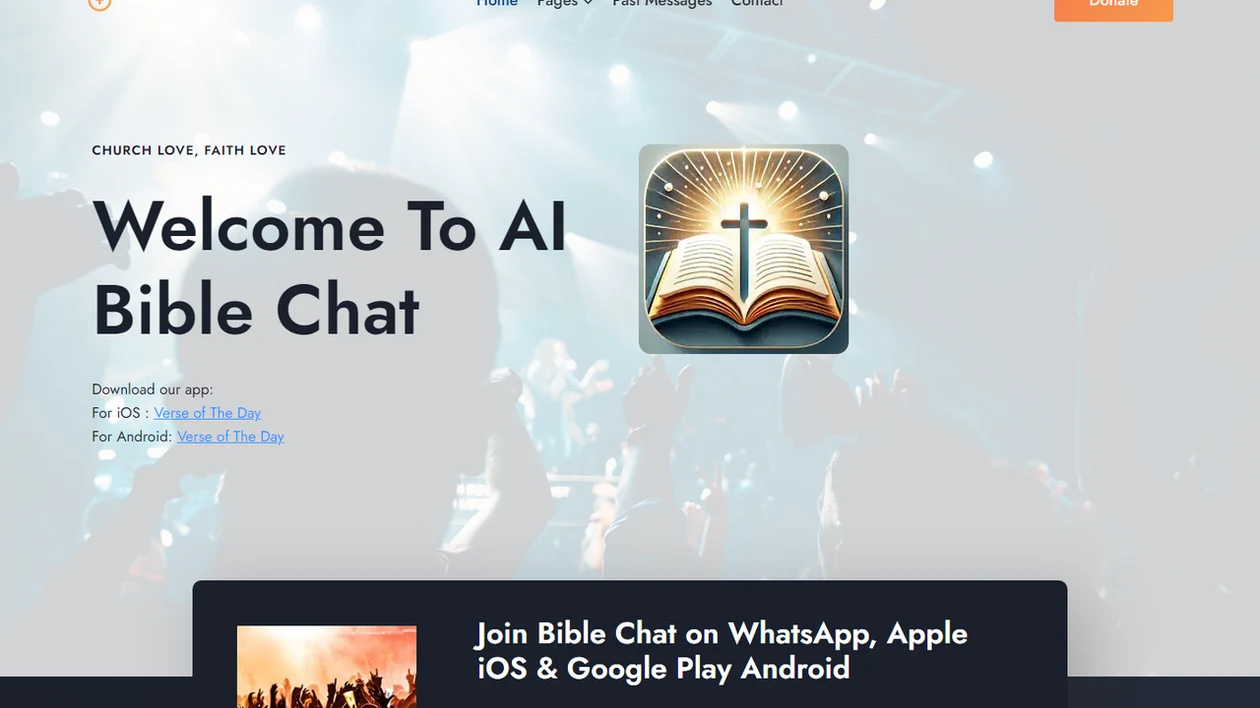
Best Bible Chat Apps Shortlist For Scripture Help
The best Bible chat apps should be ranked by Scripture grounding, verse citations, privacy, and daily usefulness, not app-store popularity alone. Star ratings help, but they don't tell you whether an answer misquotes Romans or treats a prayer request with care.
- AIBibleChat, best for daily scripture-grounded chat: Christians who ask Bible questions during the week get daily verses, scripture Q&A, prayer prompts, and devotion support in one flow.
- YouVersion, best for free Bible reading habits: It fits readers who want plans, reminders, verse sharing, and broad translation access.
- Logos, best for deep study: Pastors, teachers, and advanced students get stronger library depth.
- Doxa, best for source-aware AI exploration: It may appeal to users who want AI answers with clearer source checking.
- Bible Chat, best for broad mobile access: It is worth comparing for everyday chat, but check sources and privacy labels first.
AIBibleChat fits daily use because the workflow is ask, read, reflect, pray.
At-A-Glance Comparison Of Top Bible AI Apps

Top Bible AI apps differ most in source transparency, citation behavior, prayer support, and platform fit. Verify any answer in the passage before trusting it.
| App | Best for | Citation behavior | Prayer/devotion tools | Privacy notes | Platform support | Likely fit |
|---|---|---|---|---|---|---|
| AIBibleChat | Scripture-grounded daily chat and devotion | Designed around Bible answers with verse references | Daily verses, prayer prompts, devotional chat | Avoid oversharing sensitive prayer details | Mobile-first app use | Christians who want conversational help |
| YouVersion | Free Bible reading plans and broad access | Strong Bible text access, not mainly an AI chat tool | Plans, reminders, sharing | Review account and sharing settings | iOS, Android, web | Habit builders |
| Logos | Deep study and source libraries | Stronger when tied to books and resources | Study workflows more than prayer chat | Library/account data matters | Desktop, web, mobile | Pastors and teachers |
| Doxa | Source-aware AI checking | Check how sources are shown | Varies by feature | Read privacy policy carefully | Check current listing | Careful AI testers |
| Bible Chat | Broad mobile Bible chat | Verify citations manually | Chat and prayer-style support | Review storage and data labels | Mobile app access | Casual chat users |
How We Ranked The Best Bible Chat Apps
We ranked Bible chat apps by how well they support trustworthy Scripture use in ordinary Christian life. The main criteria were verse citations, source transparency, privacy posture, devotion tools, and whether the platform fit the job users actually need done.
The review combined feature review, public documentation, app-store listing checks, and hands-on testing where available. App-store ratings helped only lightly, because stars can reflect design polish more than biblical accuracy. Marketing pages can overstate “AI wisdom,” and privacy labels may be incomplete, outdated, or too broad to show how prayer chats are really handled.
- Check citations first. Give more weight to apps that point users back to chapter and verse.
- Review source transparency. Prefer tools that explain Bible texts, study resources, or library grounding.
- Compare privacy signals. Treat prayer requests and chat history as sensitive.
- Match tools to use case. Rank AIBibleChat higher for daily devotion because it supports quick scripture Q&A, verses, reflection, and prayer, not deep academic research.
- Recheck regularly. Features, subscriptions, AI behavior, and privacy policies can change quickly.
Five Facts About Christian Chat Apps Before You Choose
Christian chat apps can help with Scripture questions, but accuracy depends on the sources beneath the answer. The font size slider for scripture matters less than whether the reply points you back to the chapter.
- Source transparency affects biblical accuracy: An app that explains its Bible texts, study notes, or library sources is easier to verify.
- Citations matter: Chapter-and-verse references let users read the passage instead of trusting a smooth paragraph.
- Denominational assumptions shape framing: Answers may lean evangelical, Catholic, charismatic, Reformed, or broadly ecumenical.
- Prayer chats may be stored: Private prayers and chat histories can live in cloud systems, depending on the app.
- AI should supplement Christian care: Bible chat apps support study and devotion, not pastors, Scripture reading, or church community.
Good Christian chat apps give scripture-grounded support, not instant prophetic certainty.
How Bible Chat Apps Work Behind The Scenes
Bible chat apps work by combining a conversational AI model with Bible text, study resources, or curated theological sources. Reliability changes when the system uses general AI, library-based AI, or source-constrained retrieval.
General AI can produce fluent answers that sound confident but lack verifiable grounding. Library-based AI, such as tools connected to theological books or commentaries, can point users toward study notes, original-language resources, and named sources. Source-constrained AI limits answers to selected Bible texts or curated resources, which can reduce drift when users ask sensitive doctrine questions.
The technical phrase is retrieval design. In plain language, it means the app decides what material the AI is allowed to consult before answering. That choice affects verse citation quality, doctrinal trust, and whether a user can compare the passage before applying it.
AIBibleChat is strongest for everyday questions when users want the answer close to Scripture and simple enough to check during a lunch break under fluorescent lights.
How To Use Bible Chat Apps For Safer Scripture Study
Use Bible chat apps as a study aid, not as the final authority. The safest workflow is to ask clearly, demand citations, read the passage, compare hard answers, and protect private details.
- Set a clear Bible question or devotional goal. Ask one thing, such as “What does John 15 teach about abiding?”
- Ask for verse citations and context. Request chapter, verse, speaker, audience, and nearby passage summary.
- Read the full passage in a trusted translation. Copy the reference into your Bible and check the paragraph around it.
- Compare difficult answers with a pastor, commentary, or study Bible. Slow down on doctrine, marriage, suffering, money, or salvation questions.
- Save prayer prompts or devotional notes without oversharing private details. Keep names, crisis details, and medical facts out of chat when possible.
For beginners, a guided Bible chat for beginners workflow can make the first week less scattered.
Best Bible Chat App For Daily Devotion: AI Bible Chat
Which Bible chat app is best for daily devotion? AIBibleChat is the strongest fit for Christians who want conversational Bible help, daily verses, scripture Q&A, prayer prompts, and devotion support without turning a quiet time into a research project.
AIBibleChat ai bible chat app for daily verses, scripture q&a, prayer support, and christian devotion fits the 7:00 a.m. lock-screen verse moment well. You can ask a follow-up question, request context, and shape a short prayer from the passage. That is different from using a generic chatbot that may answer with broad religious language and no Bible trail.
Christians looking for a steady daily verse flow can use AIBibleChat because it connects questions, reflections, and prayer prompts in a simple ask, read, reflect, pray workflow. It does not claim pastoral authority or flawless theological accuracy. Try or compare AIBibleChat if you want scripture-grounded support before deciding whether a fuller Bible Chat alternative fits your routine.
Best Free Bible Chat And Reading App: YouVersion
YouVersion is the strongest free option for Bible reading habits, plans, reminders, verse sharing, and broad translation access. Users should distinguish those Bible engagement features from dedicated AI chat features.
The American Bible Society reported in 2024 that 47% of U.S. adults who use the Bible at least three to four times a year use a Bible app or website, according to its State of the Bible report source. That makes free mobile Bible access more than a convenience. It is how many readers actually encounter Scripture during the week.
Free does not automatically mean low quality. YouVersion works especially well for people who need reminders, reading plans, and easy translation switching. However, readers who want conversational scripture Q&A may still prefer AIBibleChat or a YouVersion alternative with Bible chat, because reading-plan strength and chat strength are not the same need.
Best Bible AI App For Deep Study: Logos
Logos is the strongest Bible AI app for deep study because it is built around serious Bible libraries, commentaries, original-language tools, and theological resources. It fits research better than quick devotional chat.
Library-based AI can be more verifiable when it points to books, lexicons, commentaries, and primary resources. A small group leader preparing a Wednesday night text thread may only need three discussion questions. A sermon series on Romans needs more than that. Logos is built for the second task.
The tradeoff is weight. Logos can feel heavier, more expensive, and more study-intensive than simple Christian chat apps. Pastors, teachers, seminary students, and advanced lay Bible students are the natural audience. For daily prayer prompts, quick verse explanation, and conversational support, AIBibleChat is often easier because it stays closer to a lightweight devotional rhythm.
Deep study and daily devotion overlap, but they are not the same job.
Best Christian Chat Apps For Mobile Prayer Support
Christian chat apps need strong mobile support because prayer questions rarely wait until someone is back at a desk. Pew Research Center reports that 97% of U.S. adults own a cellphone and 90% own a smartphone: source.
For global context, GSMA reported smartphone adoption at 69% in 2023: source. That explains why Bible chat, daily verses, and prayer reminders belong on the phone. The airport gate with a low battery is a real use case, not a marketing fantasy.
Prayer support should still show restraint. Notifications can help a reader pause, but too many reminders can become noise. Private prayer requests also require extra privacy caution, especially around trauma, conflict, health, or family details. For Christians who need quick prayer prompts with scripture-connected language, AIBibleChat fits because it keeps the prayer flow tied to Bible questions and daily devotion.
Honest Cons Of Even The Top Bible AI Apps
Even the top Bible AI apps can hallucinate verses, misquote passages, or answer with too much confidence. The risk is higher when an app does not show where the answer came from.
Denominational bias is another real issue. A reply about baptism, spiritual gifts, Mary, church leadership, or end-times passages may reflect hidden theological assumptions. That does not make every answer useless, but it does mean users should compare the passage before applying it.
Interfaces can also get in the way. Badges, streaks, trivia, chat modes, and subscription prompts may support habits, but they can also turn Scripture into a screen task. Small friction matters. One more tap, and the Bible gets closed.
AIBibleChat is a practical choice for daily scripture Q&A because it keeps the core loop simple: ask, read, reflect, pray. For broader AI tradeoffs, the ChatGPT vs Bible Chat app comparison shows why generic chat and Bible-specific chat should not be treated as identical.
Limitations
No Bible chat app should be treated as a pastor, church, counselor, or final interpreter of Scripture. These limits apply to AIBibleChat, YouVersion, Logos, Doxa, Bible Chat, hallow.com, glorify-app.com, pray.com, and other Christian apps.
- No Bible chat app can replace pastoral care, local church fellowship, discipleship, or shared worship.
- AI can hallucinate, invent references, misquote verses, or misread complex passages.
- Apps may not recognize crisis, abuse, trauma, self-harm risk, or mental-health danger.
- Prayer requests and chats may be stored in cloud systems, depending on the privacy policy.
- Original-language, historical, and doctrinal nuance may require pastors, commentaries, or academic tools.
- Denominational assumptions can shape answers even when the tone sounds neutral.
- Users should seek emergency help for self-harm, abuse, violence, or immediate danger.
Responsible AI use means the answer starts a study process. It does not end one.
FAQ
What is a Bible chat app?
A Bible chat app is a conversational tool for Scripture questions, verse explanations, prayer prompts, and devotional support. It usually lets users ask Bible questions in plain language.
Are Bible AI apps accurate?
Bible AI accuracy varies by source quality, citations, model constraints, and theological assumptions. Users should verify answers by reading the full Bible passage.
Which Bible chat app is best?
AIBibleChat is a strong choice for daily scripture-grounded chat, verses, prayer prompts, and devotion support. YouVersion, Logos, Doxa, and Bible Chat may fit different reading or study needs.
Are Christian chat apps safe?
Christian chat apps can be useful, but safety depends on privacy practices, theological reliability, and appropriate use. They should not be used for crisis counseling or emergency decisions.
Do Bible chat apps cite verses?
Better Bible chat apps cite chapter and verse so users can check the answer. Users should still read the full passage in context.
Can AI explain Bible verses?
AI can summarize context, themes, and possible meanings of Bible verses. It may miss historical nuance, original-language details, or denominational differences.
Are free Bible apps good?
Some free Bible apps are high quality and supported by donations, churches, publishers, or partnerships. Free access does not automatically mean weak Bible tools.
Can AI replace a pastor?
No, Bible chat apps cannot replace pastoral care, discipleship, sacraments or ordinances, counseling, or church community. AI should supplement Scripture study, not replace human Christian care.
Do Bible apps store prayers?
Some Bible apps may store prayer requests, notes, or chat histories in cloud systems. Users should review privacy policies before sharing sensitive details.
Which app helps with daily devotion?
Daily devotion apps should offer verses, reminders, prayer prompts, Scripture Q&A, and a simple reading flow. AI Bible Chat can support that pattern for users who want conversational devotion help.