
Prayer Data Privacy in Christian Apps

Prayer data privacy means treating prayer requests as sensitive information because they can reveal health concerns, family conflict, grief, sin struggles, children’s details, and church relationships. A Christian app should clearly explain who can see prayer requests, whether humans review them, how long they are stored, and whether they are used to improve AI systems.
Definition: Prayer data privacy is the way a Christian app collects, stores, displays, reviews, deletes, and shares personal information contained in prayer requests.
TL;DR
- Prayer requests can contain spiritual, medical, family, financial, and child-related details, so they deserve stronger safeguards than ordinary app messages.
- Users should check whether a prayer feature is private, public, community-visible, human-reviewed, or used for AI improvement.
- Christian branding does not guarantee Christian app privacy; the privacy policy, data controls, and feature design matter.
Prayer Data Privacy Definition for Christian Apps
Prayer data privacy is the way a Christian app collects, stores, displays, reviews, deletes, and shares personal information contained in prayer requests. In plain language, it covers visibility, storage, deletion, AI training use, and third-party sharing of prayer request text.
Prayer requests are unusually sensitive because people often write what they would say with bowed head in a waiting room chair. A request may include a spouse’s name, a diagnosis, grief after a death, sin struggles, abuse concerns, children’s details, debt, or church conflict.
AI Bible Chat is a Bible chat app that provides daily verses, scripture Q&A, prayer prompts, and devotion support for Christians. This article is informational only. It helps you review prayer privacy risks, but it does not replace any app’s formal privacy policy, terms, or in-app settings.
Small words can reveal a lot.
At-a-Glance Prayer Request Privacy Checklist
“Is my prayer request private before I submit it?” Use this checklist before typing anything you would not want copied, forwarded, or displayed.
- Private by default? Yes / No. Is the request visible only to you, or posted to a prayer wall?
- Human review? Yes / No. Can moderators, support staff, church leaders, or app employees read it?
- AI provider access? Yes / No. Is the text processed by an outside AI service?
- Model improvement? Yes / No. Can your prayer content be used to improve AI systems?
- Deletion controls? Yes / No. Can you delete the prayer, and does the policy explain backups?
- Export controls? Yes / No. Can you download or move your prayer history?
- Sensitive details avoided? Yes / No. Did you remove names, diagnoses, addresses, children’s school details, and identifying church information?
A privacy-respecting Christian prayer feature should feel like spiritual support, not a hidden public diary.
Five Prayer Data Privacy Facts Christians Should Know
- Prayer requests often contain highly sensitive personal data. They can mix spiritual confession with medical, family, financial, and safety concerns.
- Privacy policies should explain visibility and review. Look for clear language on private submissions, public posts, human review, and AI improvement.
- Devotional tools and social prayer walls carry different risks. A private reflection prompt is not the same as a community-visible prayer board.
- Christian branding does not automatically mean stronger privacy. Users still need to check screenshots, privacy labels, in-app purchase notes, and policy language.
- Data minimization is safer than full-detail sharing. First names, rare diagnoses, addresses, school names, and church identifiers are usually unnecessary.
Pew Research Center reported that 72% of U.S. adults pray at least occasionally and 44% pray daily (https://www.pewresearch.org/religious-landscape-study/database/frequency-of-prayer/). That means prayer apps may receive repeated, intimate disclosures from the same person over time.
Prayer Data Flow Behind Private Chat and Prayer Walls
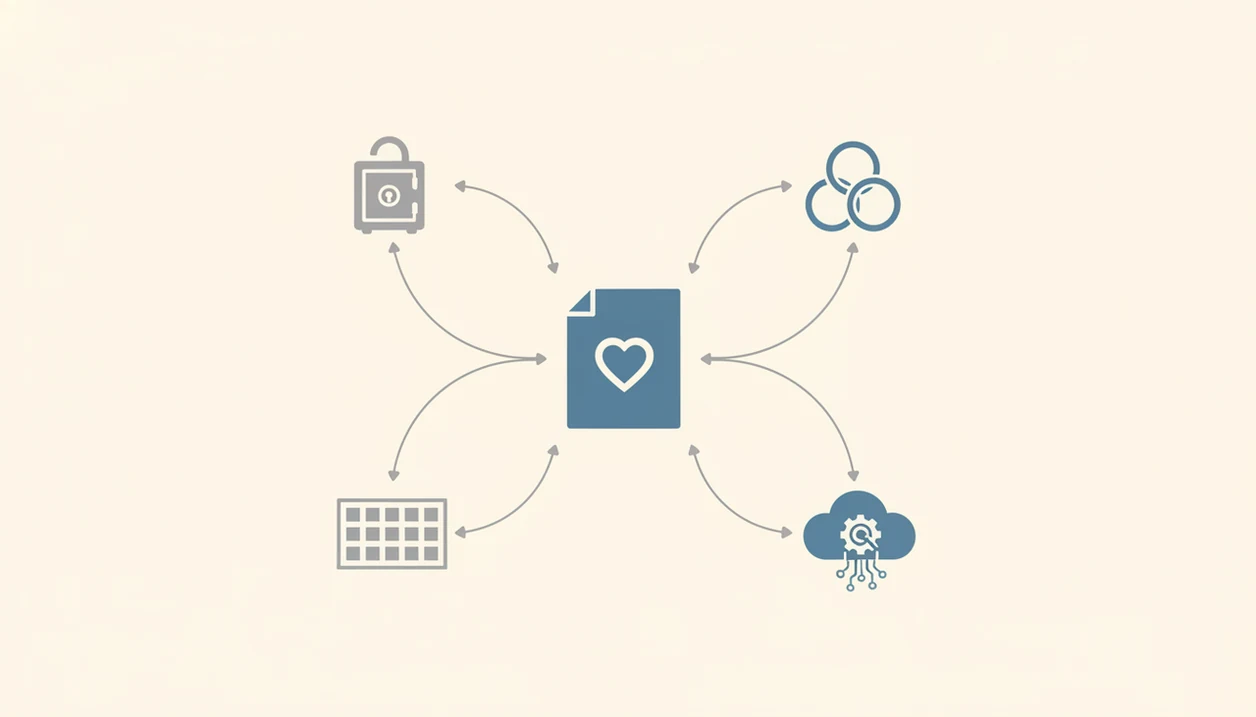
How prayer data privacy works: a user enters a request, the app processes it, and the content may be stored, routed, moderated, analyzed, or displayed. The privacy risk changes at each step.
A private one-to-one prayer chat, a church-group prayer list, and a public prayer wall are not the same privacy model. One may store text in cloud storage. Another may send it through analytics logs, a moderation queue, customer support tooling, or third-party AI processing. “Local device storage” means content stays on the phone or tablet unless synced. “Cloud storage” means it sits on a server tied to an account.
Tools like AIBibleChat, YouVersion, Hallow, Glorify, and Pray.com should be reviewed feature by feature, not by category name alone. Deletion can also be more complicated than tapping a trash icon because backups, logs, moderation records, or external processors may retain copies for a period.
Specific Christian App Privacy Guarantees to Look For
Look for concrete prayer privacy guarantees, not warm religious language. A trustworthy Christian app should make its prayer request privacy readable before the user shares a hard story.
- Private-by-default requests: Prayer text is not posted publicly unless the user chooses to share it.
- Visible public-sharing labels: Prayer walls and group posts clearly show who may see the request.
- Limited collection: The app does not ask for names, diagnoses, addresses, or church details unless needed.
- Deletion and account controls: Users can delete prayers, close accounts, and understand what remains in backups.
- Clear retention language: The policy explains how long prayer content, logs, and moderation records are kept.
Also check for statements about AI training, human review, third-party processors, encryption, and account access. Family-shared devices, minors, and church-group sharing need extra clarity. For broader app review, our AI Bible app privacy guide covers privacy labels and policy signals.
The free trial note in tiny text is worth reading.
Prayer Request Privacy Risks in Public Prayer Walls
Public prayer walls are often visible by design, so public visibility is not always a privacy failure. The risk is that users may misunderstand the audience or include details that make an “anonymous” request identifiable.
| Feature type | Who may see it | Privacy risk |
|---|---|---|
| Private prayer chat | User, app system, possible processors or support teams | Hidden review, storage, AI processing, retention |
| Group prayer list | Church group, small group, invited members | Screenshots, forwarding, church relationship exposure |
| Public prayer wall | Other app users or visitors | Broad visibility, reposting, search or screenshot risk |
| Anonymous request | Audience depends on feature settings | Weak anonymity if details identify the person |
Anonymity can collapse fast when a request mentions a rare illness, a town, a pastor’s name, or a child’s team. For community prayer, minimize details: “Please pray for a family medical decision” is often safer than a full timeline.
Prayer App Privacy Gaps HIPAA Usually Does Not Cover
“Does HIPAA protect my prayer app if I mention a diagnosis?” Usually, no. The U.S. Department of Health and Human Services explains that HIPAA applies to protected health information held by covered entities and their business associates, not most consumer prayer apps merely because a user types a health concern (https://www.hhs.gov/hipaa/for-professionals/covered-entities/index.html).
Privacy settings also cannot prevent voluntary oversharing. If someone posts a public request with a real name, hospital, and surgery date, the app may not be able to undo who already saw it.
Deleting the app from a phone may not delete server-side data. Backups, logs, analytics systems, moderation records, or customer support tickets may remain under the app’s retention rules. Screenshots, copied prayer requests, family-shared iPads, and public prayer-wall reposting also sit outside normal app control. Responsible boundaries matter here, just as they do in responsible AI Bible use.
Mental Health Disclosures in Prayer Data Privacy Boundaries
“Should I put depression, anxiety, or self-harm fears into a prayer request?” Treat those disclosures as highly sensitive, and do not post urgent safety details in public prayer spaces. Prayer support is not emergency care, medical treatment, licensed counseling, or crisis intervention.
CDC Household Pulse Survey data has repeatedly shown that anxiety and depression symptoms affect a large share of U.S. adults, including estimates around 31% in recent survey periods (https://www.cdc.gov/nchs/covid19/pulse/mental-health.htm). In real prayer tools, that can look like grief after a funeral, addiction fears, family crisis, panic before an errand, or a late-night message typed from a grocery store parking lot.
If there is immediate danger, contact local emergency services, a crisis line, a clinician, or a trusted person nearby. For spiritual and pastoral care boundaries, the question of whether an app can AI Bible app replace pastor deserves a clear answer: it cannot.
When to Seek Professional or Emergency Help
Seek professional or emergency help whenever a prayer request involves immediate danger, self-harm risk, abuse threats, or urgent mental-health distress. A prayer app can support reflection and community care, but it should not be used as the main place to handle a crisis.
When the situation is serious, choose the safest direct channel before posting anything online:
- Call local emergency services if someone may be harmed soon, has a plan to self-harm, is being threatened, or is in active danger.
- Use a crisis line or urgent mental-health service for immediate emotional support instead of putting crisis details on a public prayer wall.
- Speak with a licensed clinician for diagnosis, treatment, medication, therapy decisions, or questions about symptoms.
- Ask a pastor, elder, small-group leader, or trusted church member for spiritual care, prayer, and local support that can stay appropriately private.
- Remove identifying details before sharing any non-urgent prayer request, especially names, locations, children’s information, abuse allegations, medical specifics, or details about a third party.
A safer prayer request can still be honest: “Please pray for safety, wisdom, and help tonight” may be enough.
Limitations
Prayer request privacy can reduce risk, but it cannot remove every risk. These limits matter before you share details about yourself or someone else.
- No policy can fully prevent oversharing in a prayer request.
- Anonymous labels may be vague if identifiers, account data, or device data are still linked.
- Some protections are policy-based rather than purely technical.
- Third-party AI services can complicate retention, deletion, and processor access.
- Community prayer walls are less private by design.
- Backups, logs, moderation systems, and analytics may persist after visible deletion.
- Family-shared devices can expose otherwise private prayer content.
- Screenshots and copied requests can travel outside the app.
- Children’s information needs stricter care than adult devotional notes.
- A privacy policy can change, so users should review current app store listings and policy dates.
For families, AI Bible Chat safety for kids is a separate concern because children often cannot judge identifiability well.
FAQ
What is prayer data privacy?
Prayer data privacy is how a Christian app collects, stores, displays, reviews, deletes, and shares personal information inside prayer requests. It includes who can see the request and whether the text is used for AI improvement.
Are prayer requests private in Christian apps?
Prayer requests are private only if the feature design, settings, and privacy policy make them private. Public prayer walls, group lists, and private chats can have different rules.
Can app staff or moderators read my prayer requests?
They may be able to if the app uses human moderation, customer support review, safety review, or quality checks. The privacy policy should explain when human review happens.
Are prayer walls public to other users?
Many prayer walls are intentionally visible to other users. Before posting, check whether the request is public, group-only, anonymous, or private.
Can an AI app train on my prayers?
An AI app may use prayer text for model improvement only if its policies and settings allow that use. Check for language about AI training, model improvement, quality review, and third-party processors.
Does HIPAA cover prayer apps if I mention a health problem?
Most consumer prayer apps are not automatically covered by HIPAA just because you mention a health issue. HIPAA generally applies to covered entities and their business associates.
Should I use real names in a prayer request?
Avoid real names unless they are necessary and you have permission. Use general wording such as “a family member” or “a friend from church” when possible.
Can deleted prayers remain stored in backups or logs?
Yes, deleted prayers may remain for a time in backups, logs, moderation systems, analytics tools, or support records. The app’s retention policy should explain this.
Are anonymous prayers really anonymous?
Anonymous prayers may still be identifiable if they include names, locations, rare circumstances, church details, or linked account data. Anonymity depends on both the app design and what you write.
How do I protect children’s privacy in prayer requests?
Do not include a child’s full name, school, address, team, medical details, or location. Use broad wording and keep sensitive child information out of public prayer spaces.