
AI Bible App Privacy For Faith Questions, Prayer Notes, And Scripture Chats

Quick answer: AI Bible app privacy matters because prayer notes, confession-like questions, and spiritual struggles can reveal deeply sensitive religious beliefs. Before using any AI Bible or faith chat tool, check what data it collects, whether chats are used for AI training, who receives the data, and how easily you can delete it.
This guide is a privacy checklist, not legal, pastoral, medical, or crisis advice. If a question involves abuse, self-harm, immediate danger, or a medical emergency, use a qualified human professional or local emergency service instead of an AI Bible app.
Definition: AI Bible app privacy is the set of data practices that govern how a Bible chat or faith app collects, protects, shares, stores, trains on, and deletes personal and spiritually sensitive information.
TL;DR
- Treat prayer requests, faith questions, and notes about sin, grief, marriage, addiction, or doubt as sensitive data.
- Compare the app store privacy label with the full privacy policy, especially for chat logs, analytics, third parties, and AI training.
- Prefer faith apps that minimize data, explain encryption, name subprocessors, and provide clear access, deletion, and opt-out controls.
AI Bible App Privacy Definition And Sensitive Faith Data
AI Bible app privacy means knowing how a faith app handles the spiritual and personal information you type, save, search, or ask about. That includes chats, prayer requests, confession-like questions, bookmarks, highlights, reading plans, and patterns that may reveal religious belief.
A Bible chat prompt about Romans 7, addiction, and marriage is not just “app content.” It can expose belief, behavior, family stress, and health-adjacent struggles in one paragraph. The EU’s GDPR treats religious or philosophical beliefs as special category data, which requires stronger protection than ordinary personal data under Article 9 source.
Christian branding does not prove careful data handling. A cross in the icon, a daily verse notification, or a soft devotional tone can still sit on top of broad analytics, cloud processing, and long retention periods.
Read the policy, not only the promise.
At-A-Glance AI Bible App Privacy Checklist
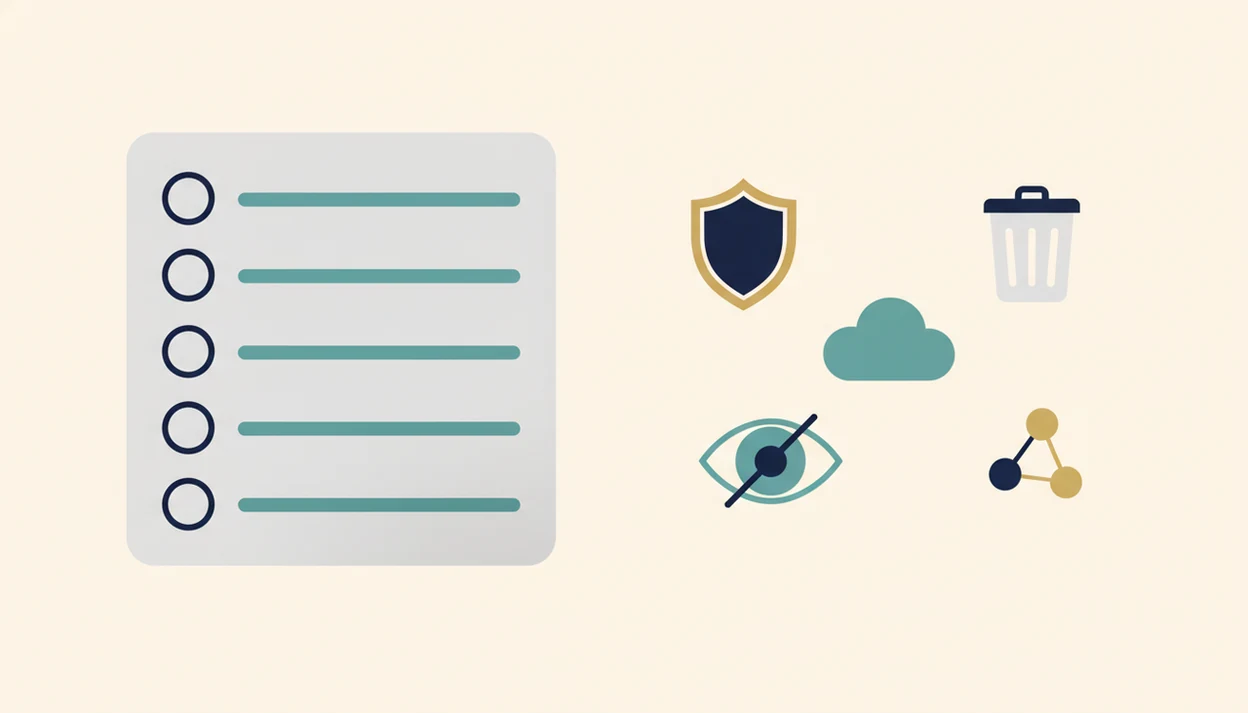
Use this checklist before installing an AI Bible app, or before typing anything you would not want tied to your name. For most users, checking the app store label first is easier than reading a full policy because it shows the main data categories quickly.
| Privacy check | What to look for | Why it matters |
|---|---|---|
| App store label | Google Play Data Safety or Apple App Privacy sections | Shows declared collection, sharing, tracking, identifiers, diagnostics, and user content |
| Chat and prayer data | Chat logs, prayer notes, saved prompts, account history | These may contain spiritual struggles, grief, doubt, or confession-like details |
| AI training terms | “Used to train,” “improve models,” “opt out,” or “not used” | AI answers and AI training are different uses of data |
| Third parties | Analytics, cloud hosting, AI providers, support tools | Data may leave the app company’s direct systems |
| User controls | Download, delete, correct, export, close account | A safer app gives you practical control |
| Permissions | Location, contacts, microphone, photos, tracking | Avoid permissions that do not fit Bible study or devotion |
We have checked labels in parking lots before opening a faith app during a stressful errand. It takes two minutes. That small pause can prevent oversharing.
Five AI Bible App Privacy Facts Every User Should Know
These five facts summarize the main privacy risks in AI Bible and faith chat apps. They are useful whether you use a daily verse app, a Scripture Q&A tool, or a prayer journal with AI features.
- AI Bible apps may collect identifiers, device information, diagnostics, and in-app behavior beyond verses, highlights, and bookmarks.
- Prayer requests and spiritual questions can be sensitive personal data because they may reveal religious beliefs, health concerns, relationships, sin struggles, or grief.
- Third-party analytics, cloud hosting, customer support systems, and AI model providers may process user data outside the app interface.
- Users in many regions may have rights to access, delete, correct, or restrict certain uses of personal data.
- A practical checklist is safer than trusting Christian branding alone.
A small group leader pasting Wednesday night questions into a text thread may not think about data categories. But the app still might.
For scripture-grounded habits, privacy review belongs beside responsible AI Bible use, not in a separate “tech people only” box.
How AI Bible App Privacy Works Behind The Scenes
AI Bible app privacy works through data flows: what you enter, where it travels, who processes it, how long it is stored, and whether it is reused. A prompt, prayer note, account email, device identifier, and tap event may all move through different systems.
When you ask a Bible chat question, the app may send your prompt to app servers, cloud hosting, analytics tools, and an AI model provider. Generating an answer is one function. Storing a chat history is another. Logging analytics is another. Training or fine-tuning a model is still another.
Encryption in transit means data is protected while moving between your device and a server. It does not automatically mean no retention, no staff access, no analytics, or no AI training. Those are policy and architecture choices.
The technical layer matters.
Most users cannot independently verify encryption, anonymization, or model-training claims without audits. That is why plain policies, subprocessors, and deletion controls matter.
7 Faith App Privacy Guarantees To Look For
A trustworthy faith app privacy policy should make specific promises, not rely on spiritual language alone. Look for these seven guarantees before entering prayer notes or sensitive Bible questions.
- Data minimization: The app collects only what is needed for prayer notes, questions, reading history, and account function.
- No-sale or no-sharing language: The policy clearly says whether personal data is sold, shared, or used for targeted advertising.
- AI training disclosure: The app states whether user chats train AI models and whether an opt-out exists.
- Encryption limits: The app explains encryption in transit and at rest, without pretending encryption solves every privacy risk.
- Named subprocessors: The policy names providers, or at least gives clear categories such as cloud, analytics, support, and AI processing.
- Export and deletion controls: Users can download data and request account deletion without chasing support for weeks.
- Youth safeguards: Children and teens get separate handling if the app is designed for them.
For families, privacy review should sit beside AI Bible Chat safety for kids, especially when teen prayer prompts are involved.
Bible App Data Safety Signals In App Stores
“Where do I check Bible app data safety before downloading?” Start with the Google Play Data Safety section source or Apple App Privacy label source, then compare it with the full privacy policy.
Inspect categories such as Data Collected, Data Linked to You, tracking, identifiers, diagnostics, purchases, location, and user content. In a Bible app, “user content” may include chat prompts, prayer notes, saved reflections, or uploaded text. On an Android phone beside an iPhone, the same app can show slightly different wording across stores.
App store approval does not guarantee strongest-practice privacy. It means the app passed platform review, not that every retention, training, or third-party sharing choice is ideal.
Large Bible app ecosystems can hold significant engagement data. YouVersion has reported more than 500 million installs worldwide source, which shows how much digital Bible behavior can exist inside one ecosystem. Scale is not bad by itself, but it raises the stakes.
AI Bible Chat Privacy Fit For Scripture Q&A And Prayer Support
AI Bible Chat is an AI-powered Bible study and prayer support app for asking Scripture questions and getting faith-based guidance. Privacy expectations matter here because Scripture Q&A, prayer prompts, and devotional reflections often include more than a verse reference.
A user may copy John 15 into a chat box, then add a sentence about loneliness, family conflict, or doubt. That second sentence changes the privacy context. AIBibleChat can support daily verses, Scripture Q&A, prayer support, and Christian devotion, but it should not be treated as pastoral confidentiality or crisis care.
Privacy review is part of responsible Christian app use. It is not fear. It is stewardship.
Tools like AIBibleChat should be reviewed the same way you would review any faith app: check the policy, app store label, deletion options, AI training language, and support contact. For interpretation boundaries, the related question is whether can AI Bible apps be wrong.
What AI Bible App Privacy Policies Do Not Cover
A privacy policy is not the same as pastoral confidentiality. It is a company document describing data practices, rights, and limits; it does not create the same relationship you have with a pastor, counselor, attorney, or clinician.
Anonymous or de-identified data can sometimes be re-identified, especially when it includes unusual details. A prayer note about a rare illness, a named town, and a church role may be easier to connect back to a person than users expect.
Encryption does not guarantee zero retention, zero analysis, or zero AI training. Third-party provider practices may also limit how much control the app company has after data moves into cloud, analytics, or AI systems.
Policies can change over time. Data breach risk also cannot be reduced to zero, even in careful systems.
If a prayer request is deeply personal, read the policy before typing it. Our separate guide to prayer data privacy covers that narrower issue in more detail.
When To Seek Human Help Instead Of An AI Bible App
Seek human help whenever the question involves safety, legal risk, trauma, abuse, self-harm, violence, or urgent medical need. An AI Bible app can support reflection and Scripture study, but it is not a substitute for emergency response, counseling, diagnosis, pastoral care, or legal advice.
Use a simple safety order before typing sensitive crisis details into any faith chat box:
- Call local emergency services immediately if someone may be harmed, abused, violent, suicidal, trapped, or in present danger.
- Contact a trusted pastor, licensed counselor, clinician, advocate, or attorney when you need confidential support from a real person with duties and training.
- Avoid entering names, addresses, church roles, screenshots, threats, medical details, or other identifying crisis information into the app.
- Use AI Bible tools for prayerful reflection, Bible passages, journaling prompts, or questions to discuss later with a human helper.
- Keep a separate list of crisis lines, church contacts, family members, and nearby friends outside the app, ideally somewhere reachable when your phone is locked or stress is high.
Privacy is important, but safety comes first.
How To Invoke AI Bible App Privacy Rights
You can invoke AI Bible app privacy rights by finding the privacy contact, support email, or request form in the app’s policy and asking for specific actions. Depending on your location and the app’s legal obligations, those actions may include access, deletion, correction, restriction, or opt-out requests.
California privacy law gives eligible residents rights such as knowing, deleting, correcting, and opting out of certain uses of personal information when a covered business collects their data source. GDPR rights may also apply to people in the EU and related jurisdictions. This is general information, not legal advice.
Save confirmation emails.
Access and download requests
Ask for a copy of account data, chat history, prayer notes, saved reflections, device identifiers, analytics identifiers, and any profile data available. Use plain wording: “Please provide the personal data associated with my account.”
Deletion and opt-out requests
Request deletion of account data and stored conversations. Also ask whether your data has been shared with AI, analytics, cloud, or support subprocessors, and whether any opt-out from training or sharing is available.
Limitations
Public privacy review has real limits. A careful checklist can reduce risk, but it cannot prove everything about an app’s internal systems.
- Users cannot fully verify encryption, anonymization, retention, or AI training claims without independent audits.
- Privacy laws vary by country, state, user age, company size, and app business model.
- De-identified spiritual data can sometimes be re-linked when details are unique.
- Breaches, misconfigurations, weak vendor controls, and insider misuse remain possible.
- Cloud hosting, analytics, and AI vendors may sit outside the user’s direct relationship with the app.
- A safer app still requires careful user choices about what to type.
- App store labels can be useful, but they are not a substitute for the full policy.
- Pastoral care, counseling, emergency help, and church accountability cannot be replaced by a privacy notice.
If your question involves immediate danger, abuse, self-harm, or a medical crisis, do not rely on an AI Bible app. Contact local emergency services or a qualified human helper.
FAQ
Are Bible apps private?
Bible app privacy varies by app. It depends on what the app collects, shares, stores, tracks, and lets users delete.
Can Bible apps track me?
Some Bible apps may collect identifiers, device data, usage behavior, diagnostics, analytics data, or location depending on permissions and policy. Check both the app store label and privacy policy.
Are prayer notes sensitive data?
Yes, prayer notes can reveal religious beliefs, health issues, relationships, sin struggles, grief, and other private matters. Treat them as sensitive before saving them in any app.
Do AI Bible chats get stored?
AI Bible chats may be stored if the app keeps conversation history, support logs, account records, or analytics events. Check the privacy policy for retention and deletion language.
Can chats train AI models?
Chats can train AI models if the app or provider allows that use. Look for explicit AI training language and opt-out terms rather than assuming chats are excluded.
Is app store approval enough?
No, Apple or Google listing approval does not prove an app follows the strongest privacy practices. Store labels are useful, but they should be compared with the full privacy policy.
Does encryption protect prayer requests?
Encryption can protect prayer requests while stored or transmitted, depending on how it is implemented. It does not automatically prevent retention, analysis, sharing, or AI training.
How do I delete Bible app data?
Use account settings if deletion tools are available, or contact the privacy email listed in the policy. Ask for deletion of account data, stored chats, prayer notes, and confirmation.
What permissions should I avoid in a Bible app?
Be cautious with unnecessary location, contacts, microphone, photo, and broad tracking permissions. A Bible study or prayer app should explain why each permission is needed.
What is faith app privacy?
Faith app privacy is the handling of personal, religious, behavioral, and devotional data in spiritual apps. It covers collection, sharing, retention, security, AI use, and deletion controls.