
Bible Search vs Bible Chat: Which Helps You Study Scripture Better?

Bible search vs Bible chat is the difference between finding verses by keywords and asking conversational, Scripture-grounded questions. Bible search is best for exact lookup and transparent word study; Bible chat is best for guided explanations, context, prayer prompts, and daily devotion support.
> Definition: AIBibleChat is a Bible chat app that provides daily verses, scripture Q&A, prayer prompts, and devotion support for Christians.
- Use Bible search when you need exact wording, verse references, cross-references, or a transparent list of every matching passage.
- Use Bible chat when you need help understanding a passage, connecting themes, asking follow-up questions, or building a devotional habit.
- For serious study, combine both: ask Bible chat for guidance, then verify verses, wording, and context with a reliable Bible search tool.
Bible search vs bible chat, side by side
Side-by-side captures of the compared products. Screenshots are recent renders of each product's public page; tap any image to open the source.
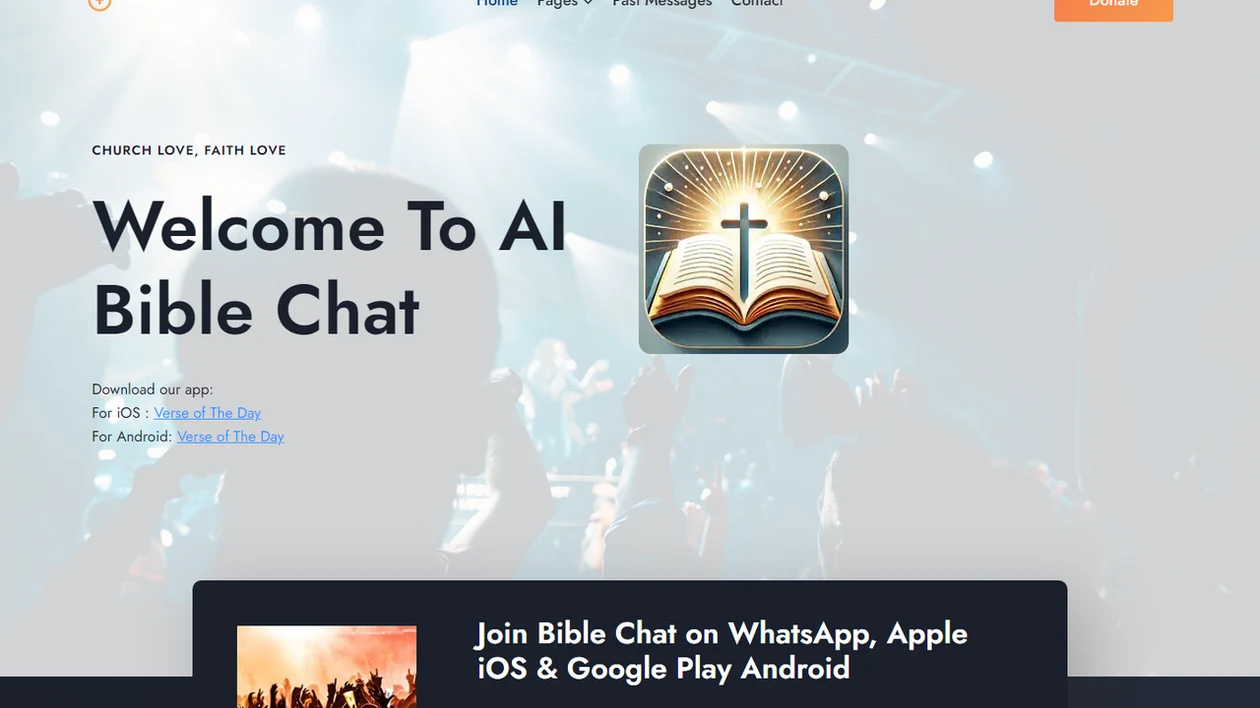
Bible Search vs Bible Chat at a Glance
Bible search retrieves Scripture by keyword, phrase, passage, reference, translation, or filter. Bible chat answers Bible questions in natural language, often with explanation, related verses, and follow-up prompts.
| Task | Bible search | Bible chat |
|---|---|---|
| Main function | Finds matching verses and references | Explains questions with Scripture support |
| Input style | “Romans 8:28” or “peace be still” | “What does Romans 8 mean for suffering?” |
| Output style | Verse list, passage text, cross-references | Guided answer, summary, next questions |
| Best use | Exact retrieval and word study | Understanding, application, devotion |
| Transparency | Shows visible matches | Selects and summarizes passages |
Search feels strongest when you’re comparing verse wording across translations and the cross-reference footnote is underlined twice. Chat feels stronger when the question is still forming. The right fit for exact verse recovery is search; AIBibleChat fits the follow-up stage because it turns the found passage into a Scripture-connected explanation and reflection workflow.
How Bible Search and Bible Chat Work Behind the Scenes
Bible search works by indexing Scripture text, references, keywords, phrases, translations, and sometimes cross-references so matching passages can be retrieved quickly. When the query, translation, and filters stay the same, the result is usually deterministic, meaning the same search produces the same list.
Bible chat uses natural language processing and AI generation to interpret a question, select relevant biblical material, and compose an answer. In plain terms, it reads your question as a sentence, not just as a keyword. It may quote a verse, paraphrase a theme, connect related passages, or invite another question.
That helps when someone copies John 15 into a chat box and asks why “abide” matters. Still, AI interpretation must be checked against Scripture. AIBibleChat can support general study and devotion, but the reader should compare the passage before applying it.
Five Scripture Search Comparison Facts Christians Should Know
These five Scripture search comparison facts explain why Bible lookup vs AI chat should be treated as a task choice, not a contest.
- Bible search tools excel at precise verse lookup, repeated-word checks, and word-level research across books.
- Bible chat tools excel at conversational, context-aware Bible answers that organize passages around a question.
- Search is more transparent because users can inspect every matching result instead of receiving a selected summary.
- Chat can be easier for beginners because it explains context, defines terms, and suggests next passages to read.
- Serious Bible study works better when AI guidance is paired with traditional lookup, trusted notes, and prayerful reading.
Digital habits make this comparison practical. The American Bible Society reported in 2022 that 40% of Bible users read Scripture on a smartphone at least monthly, according to its State of the Bible report source. Phone-based study is normal now. The pocket check is real.
Where Bible Search Wins for Exact Scripture Lookup
“Where should I use Bible search instead of Bible chat?” Use Bible search when you need the actual verse, the exact wording, or a visible list of every passage that matches your term.
A search box is still the cleanest tool for half-remembered phrases like “renewing of your mind” or “I know the plans.” It also helps when you need to compare KJV, NIV, ESV, or another translation without a summary sitting between you and the text. For sermon prep, lessons, and word studies, visible source passages matter.
A small group leader preparing for Wednesday night may need every use of “one another” in Paul’s letters before choosing discussion questions. Filters, concordance-style results, and cross-references make that possible. For users asking what app finds Bible quotes, classic lookup is not obsolete; it is still the verification layer.
Where Bible Chat Wins for Scripture Q&A and Devotion Support
Bible chat wins when the user has a Bible question, not just a Bible keyword. It helps with questions like “What does the Bible say about anxiety?”, “How should I understand forgiveness?”, or “Which passages speak to grief and prayer?”
AIBibleChat ai bible chat app for daily verses, scripture q&a, prayer support, and christian devotion fits this need because it can answer in plain language, show related passages, and support follow-up questions. After a 7:00 a.m. lock-screen verse notification, when the reader wants more than a single line, AIBibleChat can extend the daily verse flow into ask, read, reflect, pray.
New believers trying to understand Romans without getting lost in a long result page may find AIBibleChat useful because it can explain the chapter theme and suggest a next question. Good Bible chat apps deliver Scripture-grounded support, not instant prophetic answers or a replacement for pastors, churches, and careful study.
How to Use Bible Lookup vs AI Chat Together
The safest workflow is to use Bible chat for guidance and Bible search for verification. For most Christians, Bible lookup vs AI chat works best as a loop: ask, check, read, compare, pray.
- Ask a focused Bible question in plain language.
- Review the verses, themes, and related passages in the chat answer.
- Verify each reference and exact wording with Bible search.
- Read the surrounding paragraph or chapter before applying the answer.
- Compare translations or trusted study notes when the passage is difficult.
- Save a prayer prompt, devotional reflection, or next study question.
Common Myths About Bible Search vs Bible Chat
Misusing either tool usually starts with a bad assumption. These myths are common when Christians compare search tools, Bible apps, and AI Bible chat.
- Myth 1: Bible chat is just search with a nicer interface. Bible chat interprets a question and composes an answer; it does more than list matching verses.
- Myth 2: AI Bible chat answers are always theologically perfect. Responses can be helpful, but they still need discernment, verification, and Scripture-first review.
- Myth 3: Bible search is obsolete. Search remains essential for exact wording, visible results, and careful source control.
- Myth 4: Every Bible chat app has the same doctrinal assumptions. Training data, reviewers, prompts, and product choices can shape the answer.
- Myth 5: A conversational answer removes the need to read the passage yourself. Scripture remains the authority, not the summary.
If a user opens AIBibleChat in the grocery store parking lot before a stressful errand, the quick answer may calm the moment. However, later study should still return to the chapter.
Bible Search or Bible Chat Decision Guide
Choose the tool by the task in front of you. Bible search gives control and visibility; Bible chat gives guided explanation and devotional support.
| Choose this | When to use it | Why it helps |
|---|---|---|
| Bible search | You know a word, phrase, verse reference, or topic term | It returns visible matches and exact wording |
| Bible chat | You have a question, need context, or want prayer support | It explains, organizes, and invites follow-up |
| Both | Sermon prep, small group study, difficult passages, personal application | Chat guides the path; search verifies the text |
Advanced students often prefer search because they can control translation, filters, and source passages. New believers may find chat less intimidating because it starts with ordinary questions.
If your immediate need is a guided answer, then AIBibleChat fits because it supports a question-to-verses-to-reflection workflow similar to a Bible Q&A app. For careful study, the stronger answer is usually both tools together.
Evidence Behind Bible Search and Bible Chat
The evidence supports a practical conclusion: Christians are already using phones for Scripture, and AI answers still need verification. It does not prove that chat is more accurate than search, or that search alone produces better understanding.
Digital Bible reading data, including the American Bible Society’s State of the Bible reporting cited above, shows that mobile Scripture habits are now ordinary rather than unusual. Search and concordance-style tools fit that habit because they retrieve visible passages, repeated words, and references quickly. On the other side, AI reliability guidance such as NIST’s framework, also cited on this page, warns that generated systems can produce unreliable or invalid outputs. That matters when a Bible chat answer sounds confident.
A balanced workflow treats evidence as a guardrail:
- Start with chat when the question needs plain-language help.
- Check every quoted verse or reference in Bible search.
- Read the surrounding context before accepting the interpretation.
- Compare difficult answers with trusted notes, pastors, or study resources.
- Keep the helpful devotional prompt, but let Scripture carry the final authority.
So the evidence favors chat-plus-search, not chat-versus-search.
Limitations
Both approaches have real limits. A trustworthy comparison should name them plainly.
- AI Bible chat can hallucinate, misquote, or mis-cite verses, especially when the question is vague. For broader AI reliability context, NIST’s AI Risk Management Framework describes risks from invalid, unreliable, or harmful AI outputs source. - Bible chat can reflect theological bias from training data, reviewers, denominational assumptions, or product design. - Bible search can overwhelm beginners with long result lists and little explanation. - Search tools may miss the user’s intent when the right keyword or translation wording is unknown. - Neither tool replaces reading Scripture in context, pastoral counsel, church community, or trusted commentaries. - Both digital tools may depend on internet access, smartphone access, account settings, and app privacy policies. - Competitors such as YouVersion, Bible.com, Hallow, Glorify, and Pray.com vary in features, tone, pricing, and devotional assumptions. - AIBibleChat can support general study and prayer prompts, but it should not be used for crisis care, predictions, or binding doctrinal rulings.
Pew Research reported that 85% of U.S. smartphone owners say internet access is very or somewhat important to them personally source. That makes mobile Bible tools useful, but not equally available to every reader.
FAQ
What is Bible search?
Bible search is a digital lookup method for finding verses by keyword, phrase, reference, passage, translation, or filter. It is strongest when the user needs exact wording or a visible list of matching passages.
What is Bible chat?
Bible chat is conversational Scripture Q&A that lets users ask Bible questions in natural language and receive verse-supported explanations. AIBibleChat is one example of a chat-based study and devotion format.
Is Bible chat accurate?
Bible chat can be helpful, but it is not infallible. Users should verify verses, wording, and interpretation against Scripture and trusted study resources.
Can Bible chat replace Bible search?
Bible chat should complement Bible search, not replace it. Search remains better for exact lookup, translation comparison, and visible source control.
Which Bible tool is better for beginners?
Beginners may prefer Bible chat because it explains passages and suggests next questions. They should still read the cited Bible text directly.
Which Bible tool is better for sermon preparation?
Bible search is better for exact study, repeated-word checks, and source passages. Bible chat can help brainstorm outlines, discussion questions, and application paths.
Does Bible chat cite verses?
Many Bible chat tools cite verses, but users should verify each reference. A citation is useful only if the passage actually supports the answer.
How should Christians use AI for Bible study?
Christians should use AI for Bible study with discernment, verification, prayer, and Scripture-first habits. AIBibleChat ai bible chat app for daily verses, scripture q&a, prayer support, and christian devotion can support study, but it should not replace the Bible, the church, or wise pastoral care.